Chemistry · Chemical Equilibrium
Work through this past-paper style MCQ, then read the full explanation. Practice more chemistry questions on mMCQ with adaptive practice and topic analytics.
Nitrogen dioxide decomposes on heating according to the following equation:
2NO2 (g) ⇌ 2NO (g)+ O2 (g)
When 4 moles of nitrogen dioxide were put into a 1 dm3 container and heated to a constant temperature, the equilibrium mixture contained 0.8 moles of oxygen.
What is the numerical value of the equilibrium constant, Kc, at the temperature of the experiment?
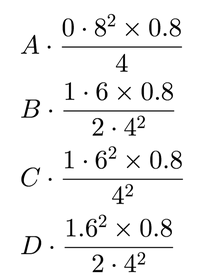
- A
Option A
- B
Option B
- C
Option C
- D
Option D
To find the numerical value of the equilibrium constant, Kc, we need to use the equilibrium concentrations of the reactants and products.
According to the given information, we start with 4 moles of nitrogen dioxide (NO2) in a 1 dm^3 container. This means the initial concentration of NO2 is 2.4 moles/1 dm^3 = 2.4 M.
At equilibrium, we have 0.8 moles of oxygen (O2) in the 1 dm^3 container. The equilibrium concentration of O2 is therefore 0.8 M.
Since the stoichiometry of the balanced equation is 2NO2 ⇌ 2NO + O2, the equilibrium concentration of nitrogen monoxide (NO) will also be 2 times the concentration of O2, which is 2 x 0.8 M = 1.6 M.
Now we can write the expression for the equilibrium constant, Kc:
Kc = [NO]2 [O2] / [NO2]2
Kc = (1.6 M)2 * (0.8 M) / (2.4 M)2
This is numerical so it can only have one correct option.
To find the numerical value of the equilibrium constant, Kc, we need to use the equilibrium concentrations of the reactants and products.
According to the given information, we start with 4 moles of nitrogen dioxide (NO2) in a 1 dm^3 container. This means the initial concentration of NO2 is 2.4 moles/1 dm^3 = 2.4 M.
At equilibrium, we have 0.8 moles of oxygen (O2) in the 1 dm^3 container. The equilibrium concentration of O2 is therefore 0.8 M.
Since the stoichiometry of the balanced equation is 2NO2 ⇌ 2NO + O2, the equilibrium concentration of nitrogen monoxide (NO) will also be 2 times the concentration of O2, which is 2 x 0.8 M = 1.6 M.
Now we can write the expression for the equilibrium constant, Kc:
Kc = [NO]2 [O2] / [NO2]2
Kc = (1.6 M)2 * (0.8 M) / (2.4 M)2
To find the numerical value of the equilibrium constant, Kc, we need to use the equilibrium concentrations of the reactants and products.
According to the given information, we start with 4 moles of nitrogen dioxide (NO2) in a 1 dm^3 container. This means the initial concentration of NO2 is 2.4 moles/1 dm^3 = 2.4 M.
At equilibrium, we have 0.8 moles of oxygen (O2) in the 1 dm^3 container. The equilibrium concentration of O2 is therefore 0.8 M.
Since the stoichiometry of the balanced equation is 2NO2 ⇌ 2NO + O2, the equilibrium concentration of nitrogen monoxide (NO) will also be 2 times the concentration of O2, which is 2 x 0.8 M = 1.6 M.
Now we can write the expression for the equilibrium constant, Kc:
Kc = [NO]2 [O2] / [NO2]2
Kc = (1.6 M)2 * (0.8 M) / (2.4 M)2
To find the numerical value of the equilibrium constant, Kc, we need to use the equilibrium concentrations of the reactants and products.
According to the given information, we start with 4 moles of nitrogen dioxide (NO2) in a 1 dm^3 container. This means the initial concentration of NO2 is 2.4 moles/1 dm^3 = 2.4 M.
At equilibrium, we have 0.8 moles of oxygen (O2) in the 1 dm^3 container. The equilibrium concentration of O2 is therefore 0.8 M.
Since the stoichiometry of the balanced equation is 2NO2 ⇌ 2NO + O2, the equilibrium concentration of nitrogen monoxide (NO) will also be 2 times the concentration of O2, which is 2 x 0.8 M = 1.6 M.
Now we can write the expression for the equilibrium constant, Kc:
Kc = [NO]2 [O2] / [NO2]2
Kc = (1.6 M)2 * (0.8 M) / (2.4 M)2
To find the numerical value of the equilibrium constant, Kc, we need to use the equilibrium concentrations of the reactants and products.
According to the given information, we start with 4 moles of nitrogen dioxide (NO2) in a 1 dm^3 container. This means the initial concentration of NO2 is 2.4 moles/1 dm^3 = 2.4 M.
At equilibrium, we have 0.8 moles of oxygen (O2) in the 1 dm^3 container. The equilibrium concentration of O2 is therefore 0.8 M.
Since the stoichiometry of the balanced equation is 2NO2 ⇌ 2NO + O2, the equilibrium concentration of nitrogen monoxide (NO) will also be 2 times the concentration of O2, which is 2 x 0.8 M = 1.6 M.
Now we can write the expression for the equilibrium constant, Kc:
Kc = [NO]2 [O2] / [NO2]2
Kc = (1.6 M)2 * (0.8 M) / (2.4 M)2
Tagged under Chemistry · Chemical Equilibrium