Chemistry · Periodicity in Elements
Work through this past-paper style MCQ, then read the full explanation. Practice more chemistry questions on mMCQ with adaptive practice and topic analytics.
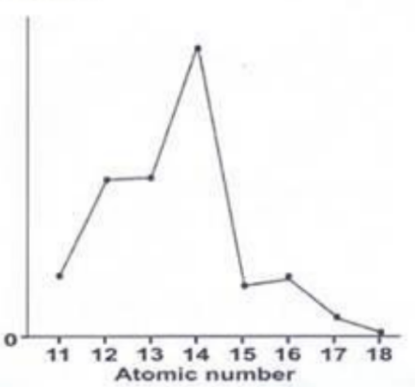
The following sketch shows the variation in a physical property of third period elements against their atomic numbers:
What physical property is plotted in this sketch?
- A
Ionization energy
- B
Melting point
- C
Ionic radius
- D
Atomic radius
Na, Mg, Al, Si are all GIANT LATTICE structures involving either metallic (Na, Mg, Al) or giant covalent macromolecule (Si) bonding. Whereas, P, S, Cl are COVALENT MOLECULES, with Ar being a monatomic nonmetal gas. Melting is achieved by disrupting the considerably weaker van der Waals intermolecular forces that exist between the molecules. Melting point steadily increases between Na and Al due to: increased metal cation charge (more protons), more delocalised e− per atom, smaller sized metal ions, hence stronger electrostatic attraction between cations and delocalised e− therefore stronger metallic bonding. Silicon has a significantly higher melting point because Silicon is a giant covalent macromolecule. In order to melt Silicon there is a need to break down many strong covalent bonds between Si atoms, that can only be achieved by applying considerable energy. Melting point of S8 > P4 > Cl2 > Ar because there is decreasing strength of vdW intermolecular forces of attraction as there is a decreasing size of molecule. This explanation is based on the known correlation between molecular size (molecular mass) and magnitude of vdW force of attraction between molecules.
The ionization energy is a measure of the capability of an element to enter into chemical reactions requiring ion formation or donation of electrons. It is also generally related to the nature of the chemical bonding in the compounds formed by the elements. See also binding energy; electron affinity.
Na, Mg, Al, Si are all GIANT LATTICE structures involving either metallic (Na, Mg, Al) or giant covalent macromolecule (Si) bonding. Whereas, P, S, Cl are COVALENT MOLECULES, with Ar being a monatomic nonmetal gas. Melting is achieved by disrupting the considerably weaker van der Waals intermolecular forces that exist between the molecules. Melting point steadily increases between Na and Al due to: increased metal cation charge (more protons), more delocalised e- per atom, smaller sized metal ions, hence stronger electrostatic attraction between cations and delocalised e- therefore stronger metallic bonding. Silicon has a significantly higher melting point because Silicon is a giant covalent macromolecule. In order to melt Silicon there is a need to break down many strong covalent bonds between Si atoms, that can only be achieved by applying considerable energy. Melting point of Sg> P4> Cl2> Ar because there is decreasing strength of vdW intermolecular forces of attraction as there is a decreasing size of molecule. This explanation is based on the known correlation between molecular size (molecular mass) and magnitude of vdW force of attraction between molecules.
The atomic radius of a chemical element is a measure of the size of its atom, usually the mean or typical distance from the center of the nucleus to the outermost isolated electron. Since the boundary is not a well-defined physical entity, there are various non-equivalent definitions of atomic radius
The atomic radius of a chemical element is a measure of the size of its atom, usually the mean or typical distance from the center of the nucleus to the outermost isolated electron. Since the boundary is not a well-defined physical entity, there are various non-equivalent definitions of atomic radius.
Tagged under Chemistry · Periodicity in Elements · 2018