Biology · Gaseous Exchange
Work through this past-paper style MCQ, then read the full explanation. Practice more biology questions on mMCQ with adaptive practice and topic analytics.
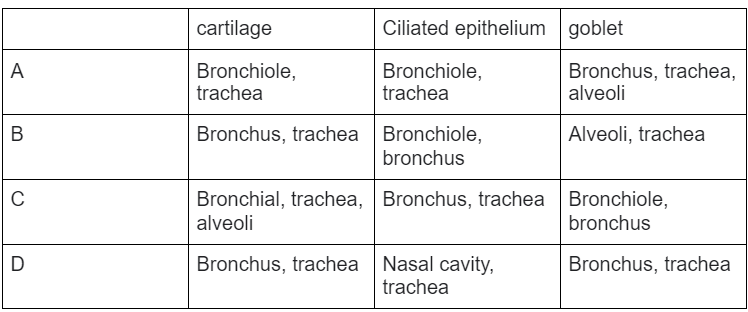
Which row correctly shows the areas of the gas exchange system that contain cartilage, ciliated epithelium and goblet cells?
- A
Option A
- B
Option B
- C
Option C
- D
Option D
It is a fact that bronchioles don't have cartilage, so options A and C are incorrect. Goblet cells are mucus secretory cells in the gas exchange system, and since alveoli don't contain mucus they have no need for goblet cells, so option B is also incorrect. This leaves option D which is the correct answer.
Bronchioles don't have cartilage. Bronchioles are the subdivisions of bronchi, and the cartliage helps maintain the structure and rigidity of bronchi. The cartilage, however, disappear when bronchi divide into bronchioles.
Goblet cells are mucus secretory cells in the gas exchange system, and since alveoli don't contain mucus, they have no need for goblet cells, so option B is also incorrect.
Bronchioles are the subdivisions of bronchi, and the cartliage helps maintain the structure and rigidity of bronchi. The cartilage however, disappear when bronchi divide into bronchioles. Alveoli are small airpackets at the end of bronchi, so they also don't have cartilage.
In option D, all the options are correctly matched, making it right.The trachea and bronchi are supported by cartilage, which keeps them open for air passage. Both the nasal cavity and trachea are lined with ciliated epithelium that helps trap and move particles out of the airway. Goblet cells are present in the trachea and bronchi, producing mucus to keep the airways moist and trap dust and microbes.
Tagged under Biology · Gaseous Exchange · 2016