A Level Economics (9708)•9708/13/O/N/23
Explanation
Price Elasticity and Total Expenditure Steps:
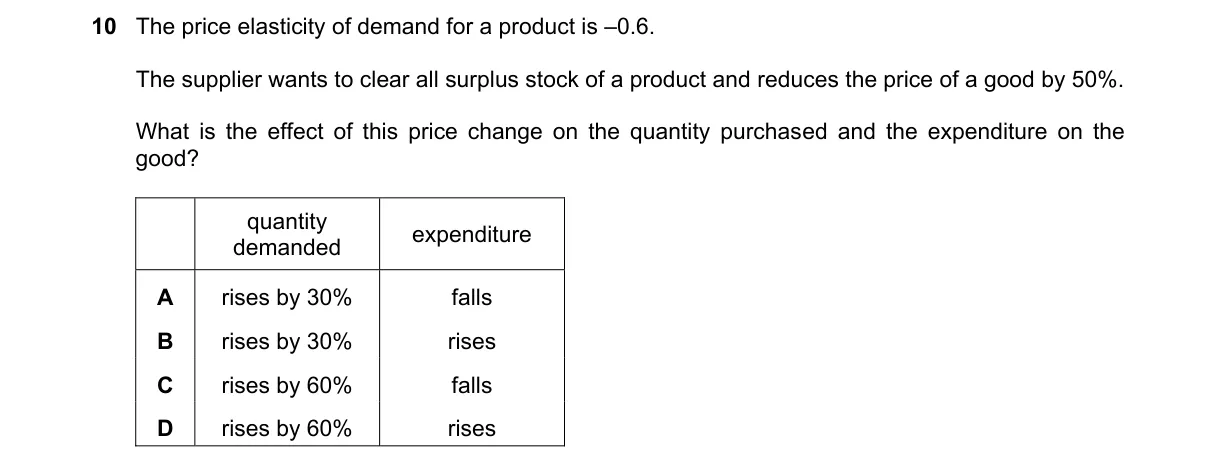
- Price elasticity of demand (PED) = %ΔQ / %ΔP = -0.6.
- %ΔP = -50%, so %ΔQ = PED × %ΔP = -0.6 × (-50%) = +30%.
- Demand is inelastic (|PED| < 1), so price decrease raises quantity but lowers total expenditure (TR = P × Q).
- %ΔTR ≈ %ΔP + %ΔQ = -50% + 30% = -20% (falls).
Why B is correct:
- Matches calculation: quantity rises 30% from inelastic response; expenditure falls per inelastic demand rule (price cut reduces revenue when |PED| < 1).
Why the others are wrong:
- A: Quantity rises (not falls) with price decrease.
- C: Expenditure falls (not rises); quantity change is 30% (not 60%).
- D: Quantity rises (not falls); expenditure falls (not rises).
Final answer: B
Topic: Price elasticity, income elasticity and cross elasticity of demand
Practice more A Level Economics (9708) questions on mMCQ.me