A Level Economics (9708)•9708/13/O/N/22
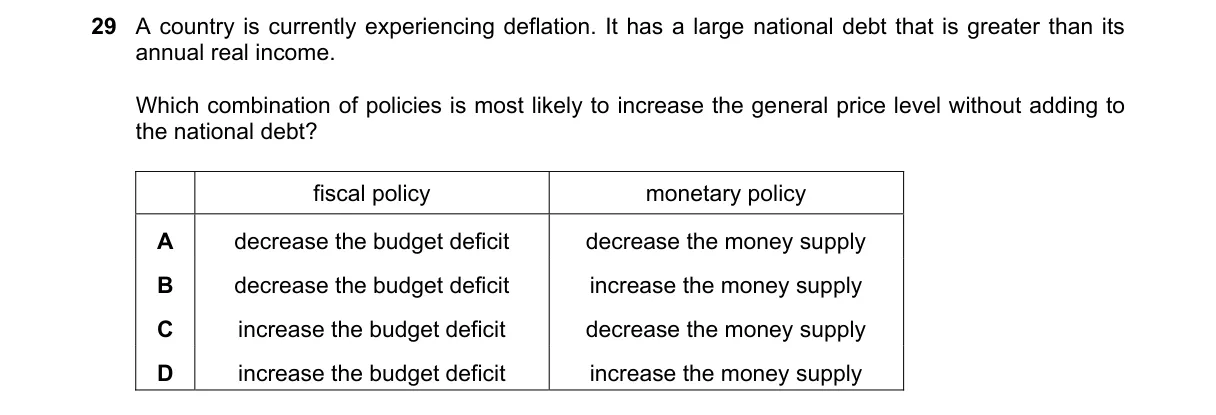
Explanation
Expansionary Policies to Combat Deflation Steps:
- Deflation lowers prices; high debt-to-income ratio worsens real debt burden, requiring inflation to erode it.
- Increasing budget deficit raises aggregate demand via government spending or tax cuts.
- Increasing money supply lowers interest rates, encouraging investment and consumption to boost demand.
- Combined expansion maximizes price level rise through multiplicative effects on output and inflation.
Why B is correct:
- Quantity theory of money (MV = PY) shows increasing money supply (M) raises prices (P) if velocity (V) and output (Y) are stable; paired with deficit spending, it strongly shifts AD rightward without net debt addition via monetization.
Why the others are wrong:
- A: Both contractionary policies reduce AD, worsening deflation.
- C: Decreasing deficit contracts fiscal AD, offsetting monetary expansion's price effects.
- D: Deficit increases AD but shrinking money supply raises rates, contracting monetary AD and limiting price rise.
Final answer: B
Topic: Effectiveness of policy options to meet all macroeconomic objectives
Practice more A Level Economics (9708) questions on mMCQ.me