A Level Economics (9708)•9708/13/O/N/22
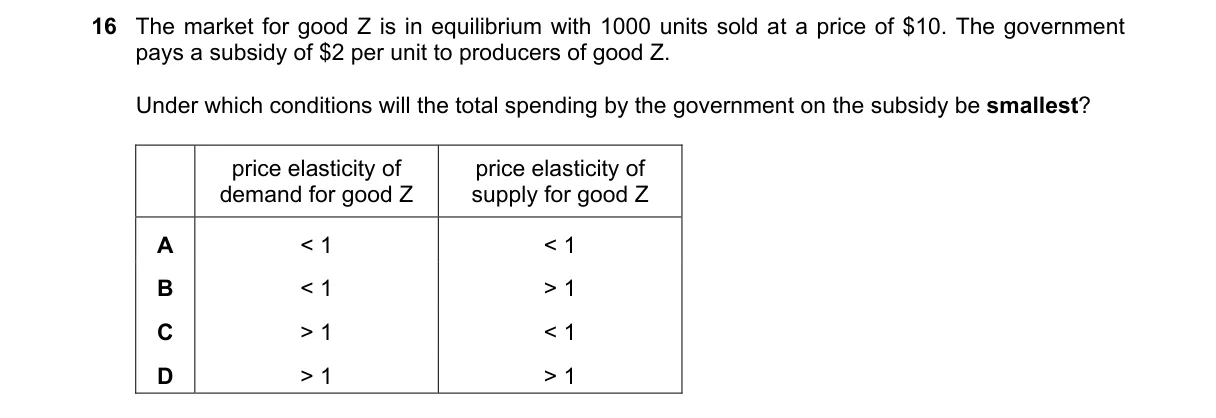
Explanation
Subsidy spending minimized with inelastic demand and supply Steps:
- Government subsidy spending = $2 × new equilibrium quantity (Q_new).
- Q_new = initial Q (1000) + ΔQ, where ΔQ > 0 after subsidy shifts supply right.
- ΔQ/Q = (10) × (ε_d × ε_s)/(ε_d + ε_s), with ε_d = |price elasticity of demand|, ε_s = price elasticity of supply.
- Minimize ΔQ by minimizing (ε_d × ε_s)/(ε_d + ε_s), which is smallest when both elasticities <1 (inelastic).
Why B is correct:
- Both inelastic curves limit quantity response to subsidy: formula (ε_d × ε_s)/(ε_d + ε_s) yields smallest value (e.g., 0.5×0.5/1=0.25), minimizing ΔQ and thus spending.
Why the others are wrong:
- A: Inelastic demand but elastic supply increases pass-through to consumers, raising ΔQ (0.5×2/2.5=0.4) and spending.
- C: Both elastic maximizes response (2×2/4=1), largest ΔQ and spending.
- D: Elastic demand with inelastic supply boosts ΔQ (2×0.5/2.5=0.4) via high demand sensitivity.
Final answer: B
Topic: Methods and effects of government intervention in markets
Practice more A Level Economics (9708) questions on mMCQ.me