A Level Economics (9708)•9708/11/O/N/21
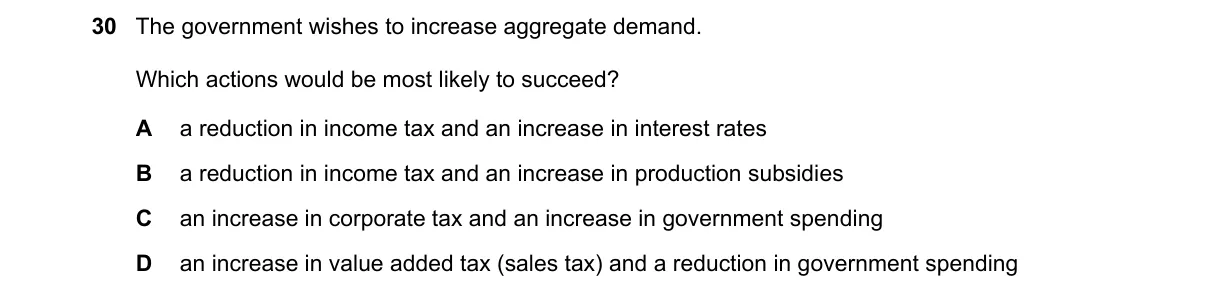
Explanation
Fiscal Policies to Boost Aggregate Demand
Steps:
- Define aggregate demand (AD) as total spending: AD = C + I + G + (X - M).
- Assess each option's impact on AD components: consumption (C), investment (I), government spending (G), and net exports (X - M).
- Identify policies that increase C, I, or G without counteracting effects.
- Select the option with the strongest net positive impact on AD.
Why B is correct:
- Reduction in income tax raises disposable income, increasing consumption (C); higher subsidies reduce production costs, boosting investment (I) and consumption, per the AD formula.
Why the others are wrong:
- A: Tax cut boosts C, but higher interest rates raise borrowing costs, reducing I and C.
- C: Higher taxes lower disposable income and C; increased G raises AD but is offset by tax hike.
- D: Higher VAT reduces consumer spending (C); lower G directly cuts AD.
Final answer: B
Topic: Effectiveness of policy options to meet all macroeconomic objectives
Practice more A Level Economics (9708) questions on mMCQ.me