A Level Economics (9708)•9708/12/O/N/20
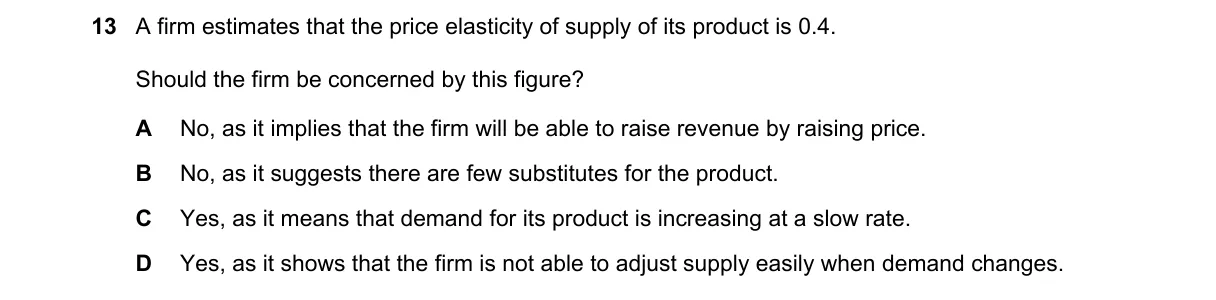
Explanation
Price Elasticity of Supply Measures Supply Responsiveness
Steps:
- Define price elasticity of supply (PES) as the percentage change in quantity supplied divided by percentage change in price.
- Calculate interpretation: PES = 0.4, which is less than 1 in absolute value, indicating inelastic supply.
- Assess implications: Inelastic supply means quantity supplied responds little to price changes, limiting the firm's ability to meet demand fluctuations.
- Determine concern: Yes, the firm should worry about inflexibility in production scaling.
Why D is correct:
- PES < 1 defines inelastic supply, meaning the firm cannot easily increase output when demand rises and prices increase, per the elasticity formula %ΔQs / %ΔP = 0.4.
Why the others are wrong:
- A: Revenue effects depend on price elasticity of demand, not supply.
- B: Few substitutes relate to demand elasticity, not supply.
- C: Supply elasticity does not indicate demand levels.
Final answer: D
Topic: Price elasticity of supply
Practice more A Level Economics (9708) questions on mMCQ.me