A Level Economics (9708)•9708/13/O/N/19
Explanation
Tax Incidence and Elasticity
Steps:
- A tax shifts the supply curve up by the tax amount, creating a price wedge.
- The tax burden on consumers is the price increase they pay; on producers, the price reduction they receive.
- Burden falls more on the less elastic side: inelastic demand means consumers bear more as they reduce quantity little.
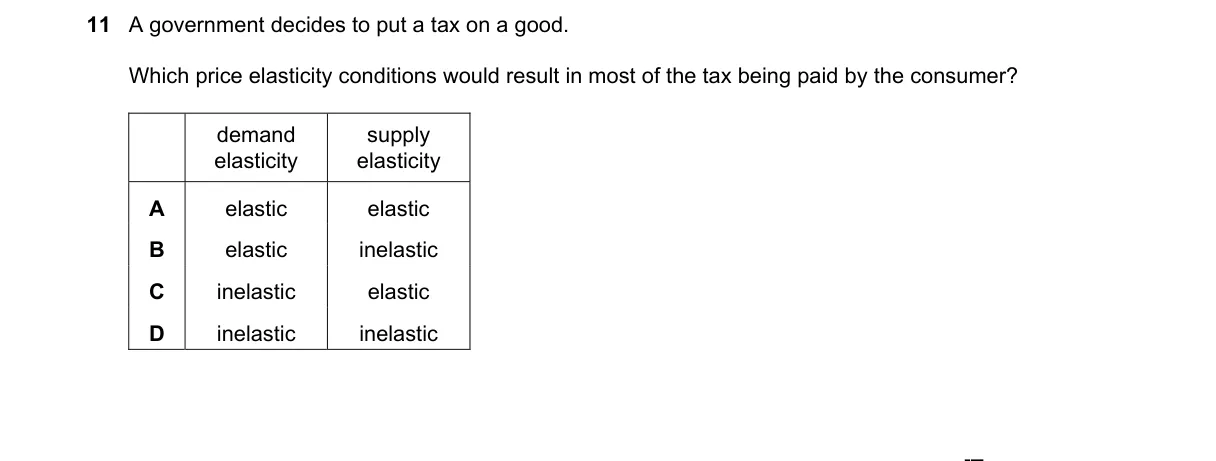
- To maximize consumer burden, demand must be inelastic (low responsiveness) and supply elastic (high responsiveness, allowing full pass-through).
Why B is correct:
- Per tax incidence formula, consumer share = Es / (Es + Ed); high Es (elastic supply) and low Ed (inelastic demand) make this near 1, so consumers pay most.
Why the others are wrong:
- A: Both elastic means equal sharing, not most on consumers.
- C: Elastic demand lets consumers avoid burden by reducing quantity; inelastic supply forces producers to absorb more.
- D: Both inelastic means equal sharing, not most on consumers.
Final answer: B
Topic: Methods and effects of government intervention in markets
Practice more A Level Economics (9708) questions on mMCQ.me