A Level Economics (9708)•9708/13/O/N/18
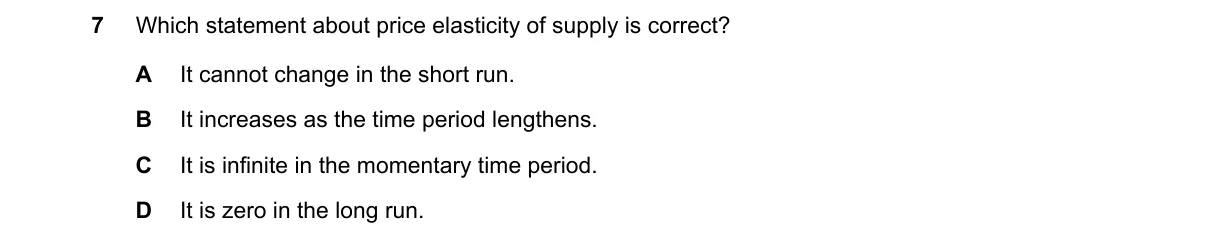
Explanation
Supply Elasticity Varies by Time Period
Steps:
- Price elasticity of supply (PES) measures how quantity supplied responds to price changes, calculated as (%ΔQ_s / %ΔP).
- In the momentary period, supply is fixed, so PES = 0 (perfectly inelastic).
- In the short run, limited adjustments make PES low but positive.
- In the long run, full adjustments (e.g., new capacity) make PES higher and more responsive.
Why B is correct:
- Economic theory states PES increases with time as producers gain flexibility to expand output, aligning with the law of supply responsiveness.
Why the others are wrong:
- A: PES can change in the short run due to minor adjustments like overtime, though it's typically low.
- C: PES is zero (perfectly inelastic) in the momentary period, not infinite.
- D: PES is highly elastic (often greater than 1) in the long run, not zero.
Final answer: B
Topic: Price elasticity of supply
Practice more A Level Economics (9708) questions on mMCQ.me