A Level Economics (9708)•9708/13/O/N/18
Explanation
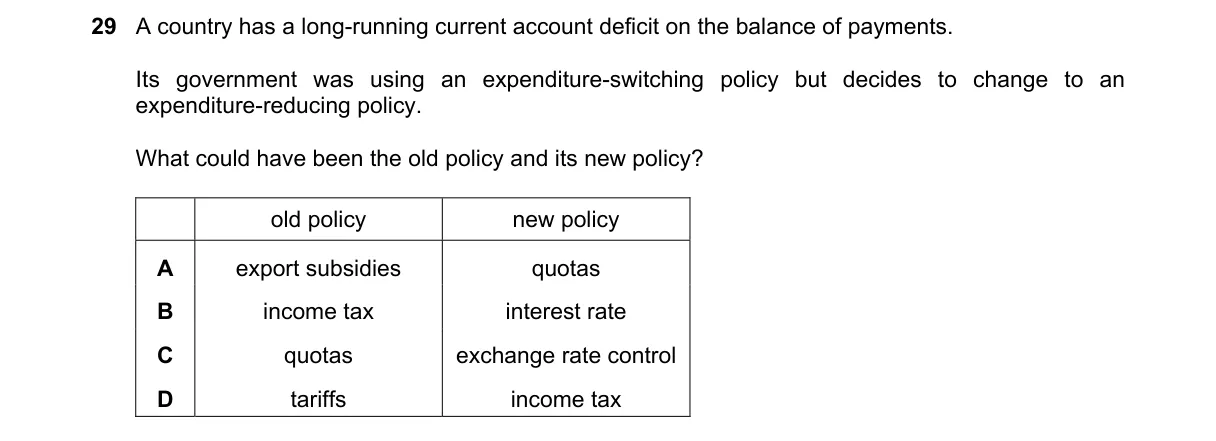
Policy shift from expenditure-reducing to switching for current account deficit
Steps:
- Expenditure-reducing policies cut total spending to curb imports, like raising income taxes.
- Expenditure-switching policies redirect spending to domestic goods, like imposing tariffs on imports.
- The change requires old policy as reducing (e.g., income tax) and new as switching (e.g., tariffs).
- Choice D fits: income tax (old, reducing) and tariffs (new, switching).
Why D is correct:
- Income tax is expenditure-reducing as it lowers disposable income and total absorption per the absorption approach (CA = Y - A), while tariffs are expenditure-switching by raising import prices to favor domestic production.
Why the others are wrong:
- A: Export subsidies and quotas both switch expenditure toward domestic/export goods.
- B: Income tax and interest rate control (e.g., higher rates) both reduce overall expenditure.
- C: Quotas and exchange rate control (e.g., devaluation) both switch spending to domestic alternatives.
Final answer: D
Topic: Policies to correct imbalances in the current account of the balance of payments
Practice more A Level Economics (9708) questions on mMCQ.me