A Level Economics (9708)•9708/14/M/J/25
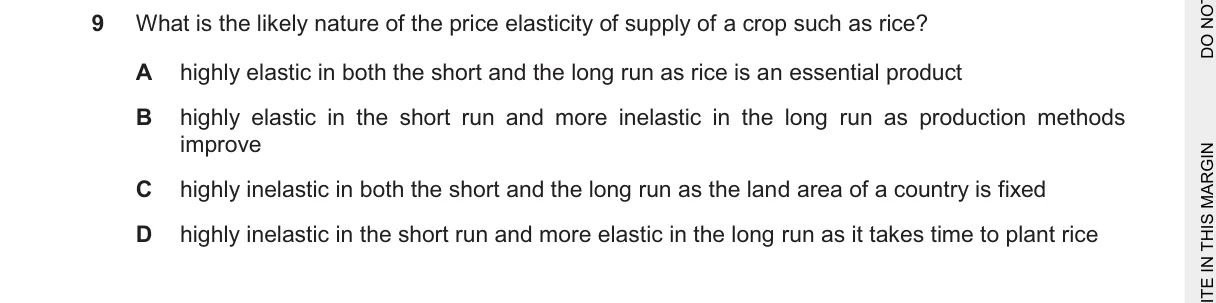
Explanation
Time Horizon Affects Supply Elasticity for Crops
Steps:
- Price elasticity of supply (PES) measures responsiveness of quantity supplied to price changes.
- In the short run for rice, output is fixed by planting and harvest cycles, making supply inelastic.
- In the long run, farmers can adjust land use and inputs, making supply more elastic.
- Option D matches this pattern, explaining the time factor in planting.
Why D is correct:
- Agricultural supply follows the law of variable proportions: short-run inelasticity due to fixed factors (e.g., planting lag), long-run elasticity as all inputs adjust (PES > 1 possible).
Why the others are wrong:
- A: Essentiality affects demand elasticity, not supply; rice supply remains inelastic short-term regardless.
- B: Production methods improve long-run elasticity, but short-run supply is inelastic, not highly elastic.
- C: Fixed land constrains long-run supply, making it less elastic overall, not highly elastic.
Final answer: D
Topic: Price elasticity of supply
Practice more A Level Economics (9708) questions on mMCQ.me