A Level Economics (9708)•9708/12/M/J/25
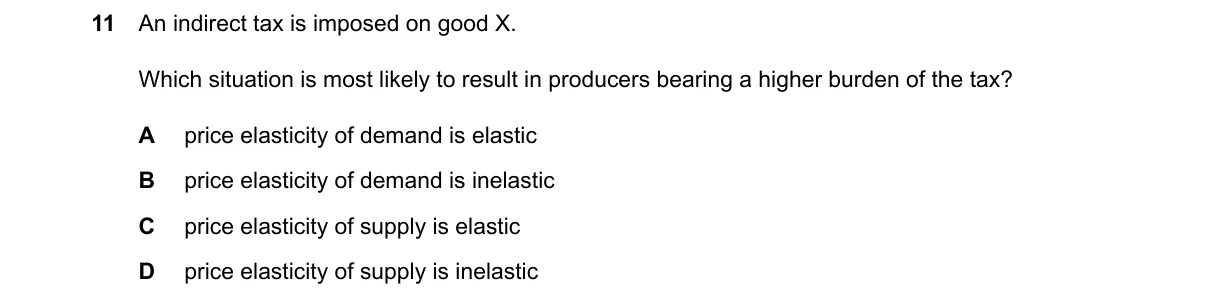
Explanation
Tax Burden on Producers from Elastic Demand
Steps:
- Recall that indirect tax incidence divides burden based on price elasticities of demand (Ed) and supply (Es).
- Use formula: Producers' burden share = Ed / (Ed + Es).
- Higher Ed increases producers' share by raising numerator.
- Compare options to identify which maximizes producers' burden.
Why A is correct:
- Elastic demand (high Ed) raises the numerator in the incidence formula, so producers absorb more tax as consumers reduce quantity sharply.
Why the others are wrong:
- B: Elastic supply (high Es) increases denominator, reducing producers' burden share.
- C: Inelastic demand (low Ed) lowers numerator, shifting more burden to consumers.
- D: Inelastic supply (low Es) decreases denominator but assumes fixed Ed; alone, it increases producers' share, yet elastic demand (A) more directly forces producers to bear higher burden via consumer sensitivity.
Final answer: A
Topic: Methods and effects of government intervention in markets
Practice more A Level Economics (9708) questions on mMCQ.me