A Level Economics (9708)•9708/13/M/J/24
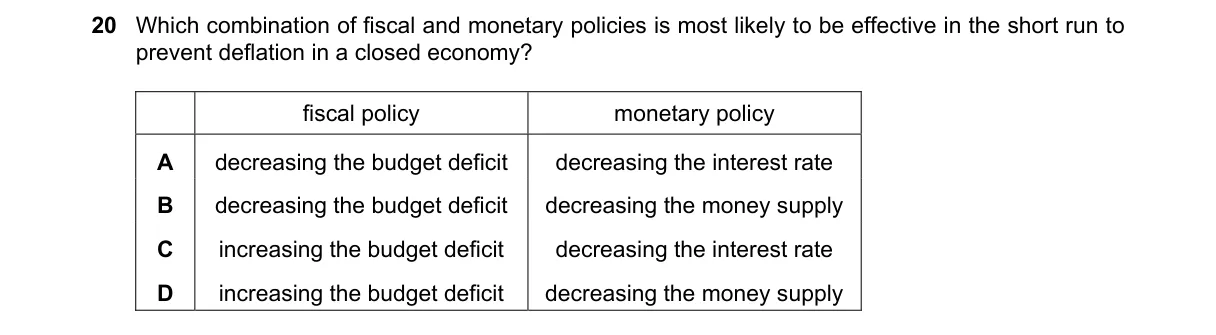
Explanation
Contractionary Policies to Curb Aggregate Demand
Steps:
- Identify goal: Prevent inflation by reducing aggregate demand (AD) in short run.
- Fiscal policy: Decreasing budget deficit is contractionary (cuts G or raises T, lowers AD); increasing deficit is expansionary (raises AD).
- Monetary policy: Decreasing money supply is contractionary (raises interest rates, cuts investment and AD); decreasing interest rate is expansionary (boosts investment and AD).
- Effective combo: Both policies contractionary to shift AD left, stabilizing prices.
Why B is correct:
- Combines contractionary fiscal (decrease deficit) and monetary (decrease money supply) policies, reducing AD per IS-LM model in closed economy.
Why the others are wrong:
- A: Expansionary monetary (decrease interest rate) offsets contractionary fiscal, insufficient AD reduction.
- C: Both expansionary, increases AD and worsens inflation.
- D: Expansionary fiscal (increase deficit) offsets contractionary monetary, net AD effect unclear or positive.
Final answer: B
Topic: Effectiveness of policy options to meet all macroeconomic objectives
Practice more A Level Economics (9708) questions on mMCQ.me