A Level Economics (9708)•9708/13/M/J/23
Explanation
Comparative Advantage Leads to Specialization Gains Steps:
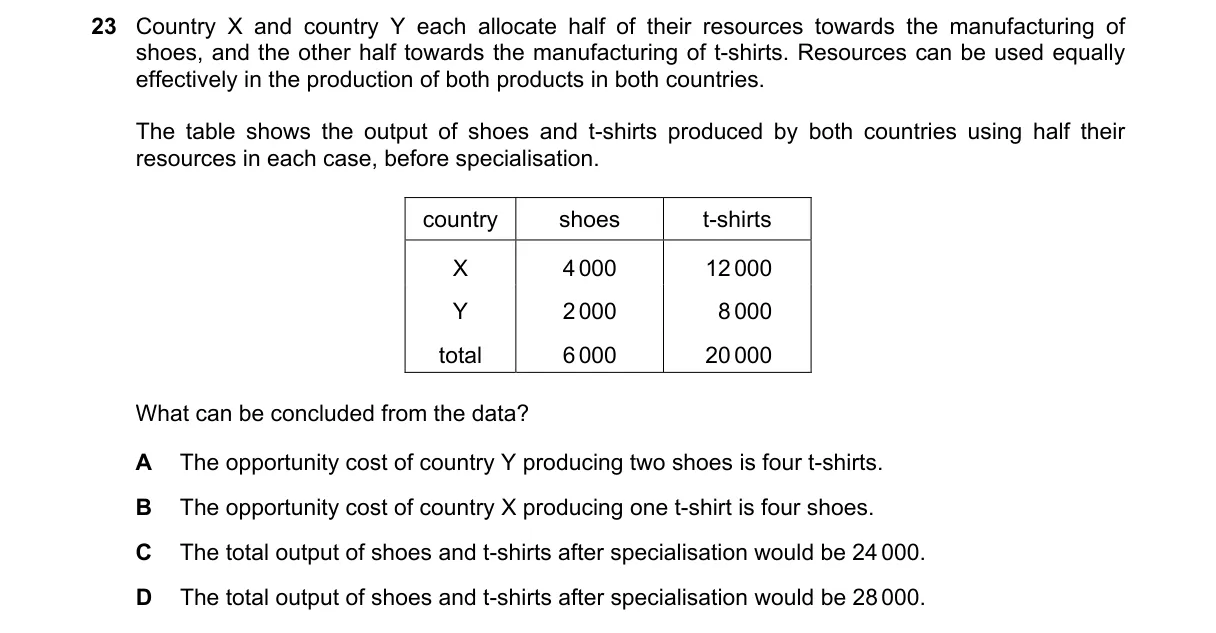
- Calculate opportunity cost of shoes (in t-shirts forgone): X = 12,000 / 4,000 = 3 t-shirts per shoe; Y = 20,000 / 8,000 = 2.5 t-shirts per shoe.
- Y has lower opportunity cost for shoes, so specializes in shoes using all resources (8,000 × 2 = 16,000 shoes).
- X has lower opportunity cost for t-shirts, so specializes in t-shirts using all resources (12,000 t-shirts).
- Total output after specialization = 16,000 shoes + 12,000 t-shirts = 28,000 units. Why C is correct:
- Specialization according to comparative advantage reallocates resources to maximize efficient production, yielding 28,000 total units versus current 44,000, but enabling trade gains beyond autarky mix (law of comparative advantage). Why the others are wrong:
- A: Y's opportunity cost is 2.5 t-shirts per shoe, so two shoes cost 5 t-shirts, not 4.
- B: X's opportunity cost is 1/3 shoe per t-shirt, not 4 shoes.
- D: 20,000 assumes half-resource outputs without full reallocation (8,000 + 12,000).
Final answer: C
Topic: The reasons for international trade
Practice more A Level Economics (9708) questions on mMCQ.me