A Level Economics (9708)•9708/13/M/J/23
Explanation
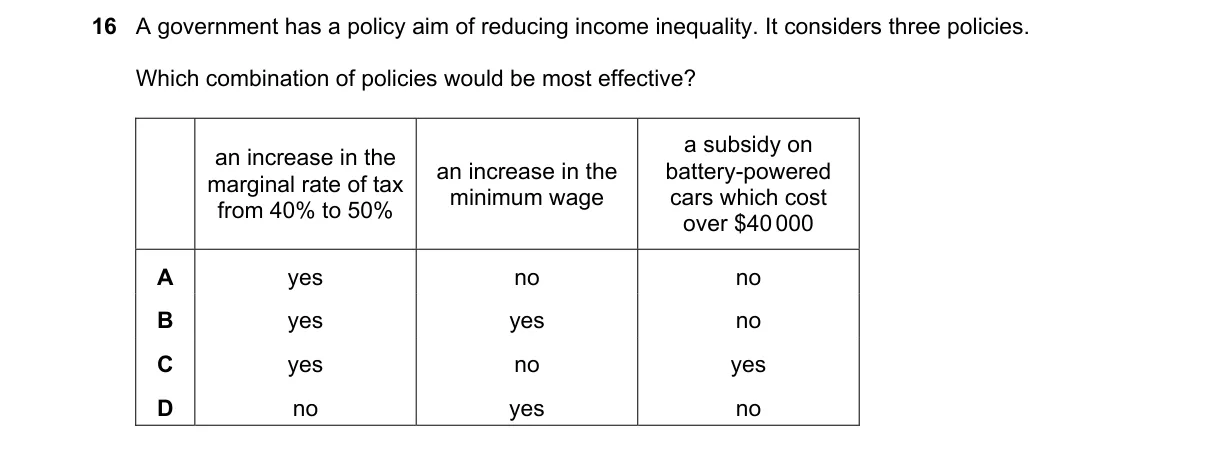
Combining progressive taxes and wage increases targets inequality from both ends
Steps:
- Define income inequality as the gap between high and low earners.
- Assess policies: progressive taxes redistribute from rich to poor; minimum wage lifts low incomes; subsidies must aid the disadvantaged.
- Compare combinations: effective ones address both top (tax) and bottom (wage) of income distribution.
- Select the pair that maximizes redistribution without favoring the wealthy.
Why B is correct:
- Progressive taxation (higher marginal rates) reduces top incomes via the ability-to-pay principle, while minimum wage raises bottom incomes, narrowing the Gini coefficient for inequality.
Why the others are wrong:
- A: Taxes high earners but ignores boosting low wages, limiting overall redistribution.
- C: Tax helps, but luxury car subsidy ($40,000+) primarily benefits affluent buyers, exacerbating inequality.
- D: Raises low wages but doesn't curb high incomes, allowing the top to pull further ahead.
Final answer: B
Topic: Equity and redistribution of income and wealth
Practice more A Level Economics (9708) questions on mMCQ.me