A Level Economics (9708)•9708/14/M/J/22
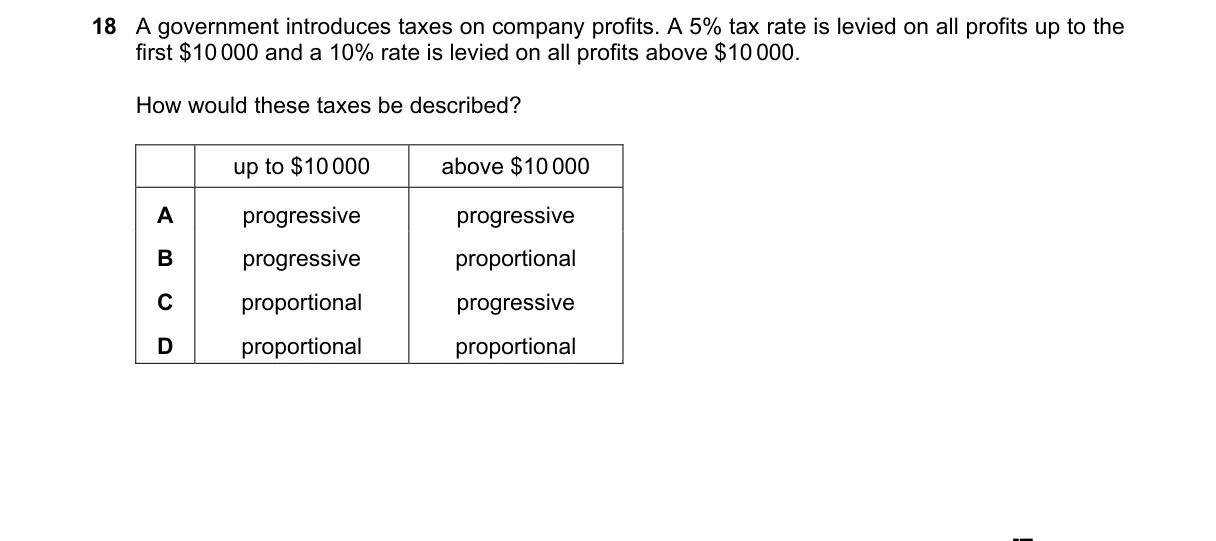
Explanation
Bracketed Tax Rates as Proportional in Each Segment
Steps:
- Examine the tax on profits up to $10,000: a flat 5% rate applies to the entire amount, defining it as proportional.
- Examine the tax on profits above $10,000: a flat 10% rate applies only to the excess, defining it as proportional on that portion.
- Recognize that proportional taxation means a constant percentage rate on the base, which holds for both brackets.
- Conclude the description matches "proportional proportional" for the two distinct rates.
Why D is correct:
- Each rate is a fixed percentage on its specific profit segment, aligning with the definition of proportional taxation (constant rate per base).
Why the others are wrong:
- A: Wrong; neither rate increases within its base, so not progressive (which requires rising rates with income levels).
- B: Wrong; the second rate is proportional on the excess, not progressive.
- C: Wrong; identical to B, misclassifies the second rate as progressive.
Final answer: D
Topic: Equity and redistribution of income and wealth
Practice more A Level Economics (9708) questions on mMCQ.me