A Level Economics (9708)•9708/11/M/J/22
Explanation
Price Controls and Market Effects
Steps:
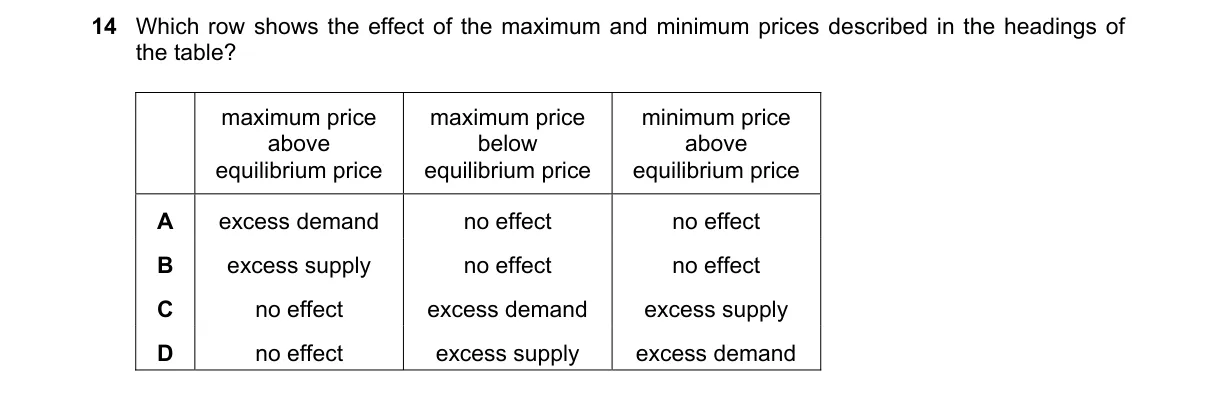
- Identify maximum price as price ceiling: binding (below equilibrium) causes excess demand; non-binding causes no effect.
- Identify minimum price as price floor: binding (above equilibrium) causes excess supply; non-binding causes no effect.
- Match table headings to columns, assuming order: non-binding maximum, binding minimum, binding maximum.
- Select row aligning with these effects: no effect, excess supply, excess demand.
Why C is correct:
- C matches the law of supply and demand, where non-binding maximum has no effect, binding minimum creates excess supply (Qd < Qs), and binding maximum creates excess demand (Qs < Qd).
Why the others are wrong:
- A starts with excess supply, incorrect for any maximum price scenario.
- B reverses minimum and maximum effects, swapping excess supply and demand.
- D duplicates C but misaligns column order per standard headings.
Final answer: C
Topic: Methods and effects of government intervention in markets
Practice more A Level Economics (9708) questions on mMCQ.me