A Level Economics (9708)•9708/13/M/J/21
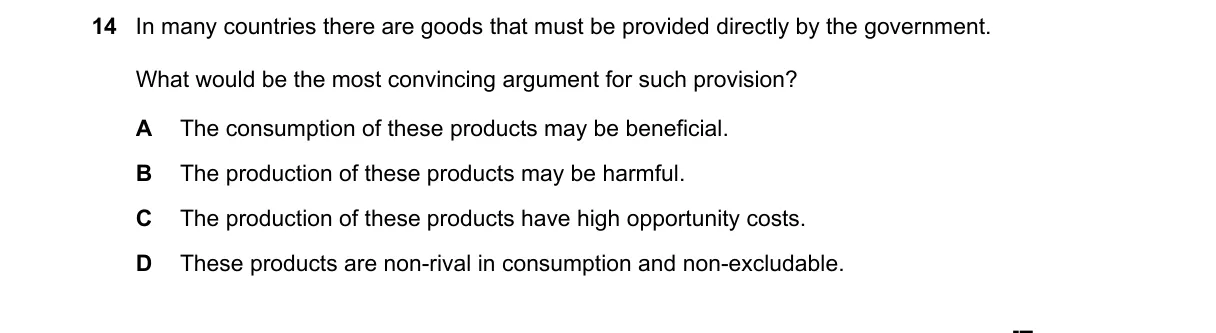
Explanation
Public Goods and Market Failure
Steps:
- Recognize that government direct provision targets market failures where private markets underprovide goods.
- Identify key characteristics: goods that are non-rival (one person's use doesn't reduce availability for others) and non-excludable (hard to prevent non-payers from benefiting).
- Match these traits to option D, as they cause free-rider problems, making private supply inefficient.
- Eliminate other options, as they don't explain why government must provide directly.
Why D is correct:
- Public goods, defined as non-rival and non-excludable, lead to the free-rider problem under the Samuelson condition for efficient provision, requiring government intervention to achieve optimal supply.
Why the others are wrong:
- A: Beneficial consumption (merit goods) can be encouraged via subsidies, not requiring direct government provision.
- B: Harmful production justifies regulation or bans, not government production.
- C: Opportunity costs apply to all goods, not uniquely justifying government provision.
Final answer: D
Topic: Reasons for government intervention in markets
Practice more A Level Economics (9708) questions on mMCQ.me