A Level Economics (9708)•9708/11/M/J/21
Explanation
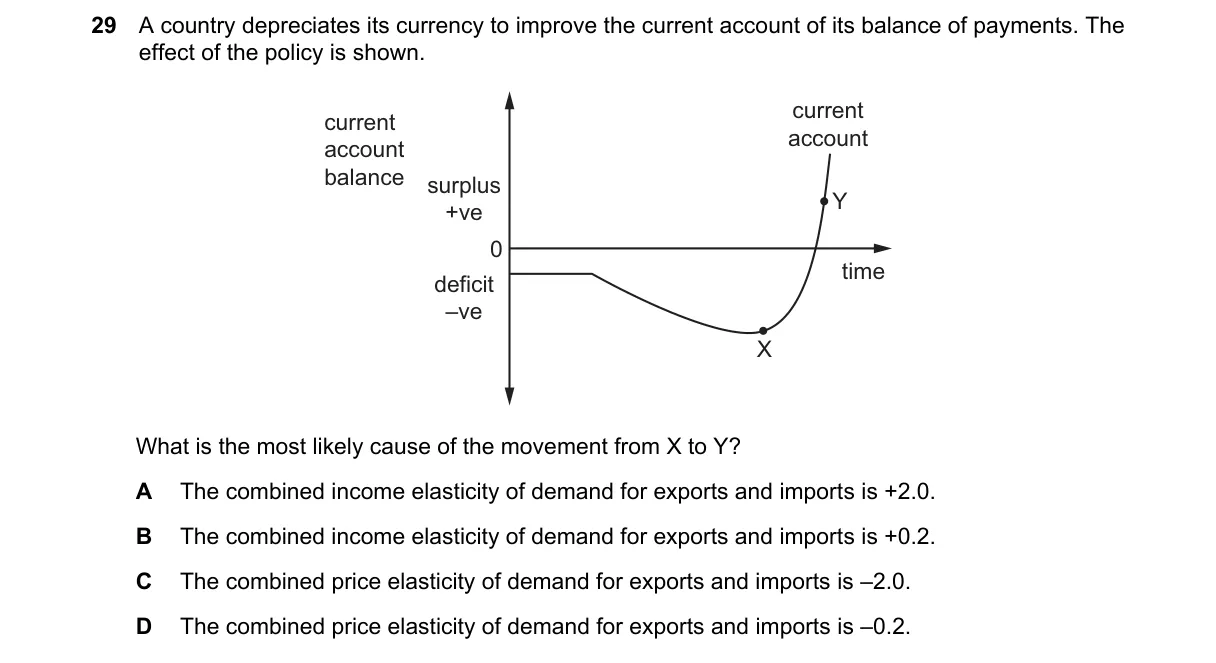
J-Curve Effect from Low Price Elasticities
Steps:
- Currency depreciation raises import prices and lowers export prices in domestic terms.
- If price elasticities are low (inelastic demand), import volumes fall little but values rise, while export volumes rise little, worsening the current account initially (X as deeper deficit).
- Over time, quantities adjust as consumers switch, leading to net improvement (Y as surplus).
- Low combined price elasticity (<1) explains the delayed positive shift shown over time.
Why C is correct:
- Marshall-Lerner condition requires sum of price elasticities >1 for improvement; 0.2 (<1) causes short-run worsening then long-run gain via J-curve.
Why the others are wrong:
- A: Income elasticity affects trade response to GDP changes, not price effects of depreciation.
- B: Elasticity of 2.0 (>1) would cause immediate surplus, not delayed movement over time.
- D: Income elasticity of 0.2 is irrelevant to depreciation's price mechanism.
Final answer: C
Topic: Policies to correct imbalances in the current account of the balance of payments
Practice more A Level Economics (9708) questions on mMCQ.me