A Level Accounting (9706)•9706/13/O/N/23
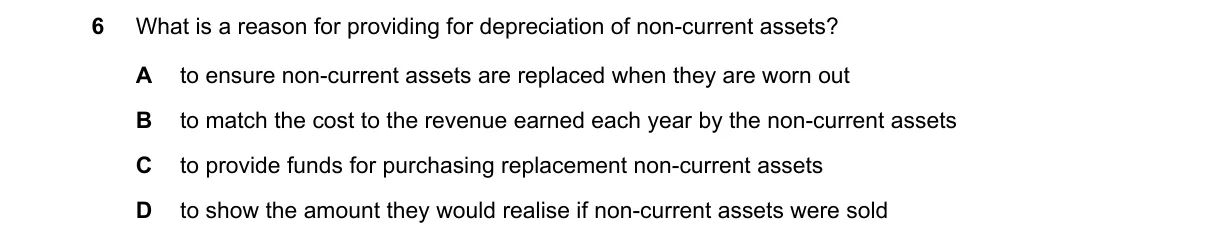
Explanation
Matching Principle in Accounting Steps:
- Identify the purpose of depreciation: it allocates the cost of non-current assets over their useful life.
- Recall the matching principle: expenses must be recorded in the same period as the revenues they help generate.
- Evaluate choices: A aligns with matching costs to revenues; B confuses asset types and replacement; C misstates depreciation as cash provision; D relates to valuation, not allocation.
- Confirm A as the standard accounting reason.
Why A is correct:
- Depreciation follows the matching principle, spreading an asset's cost against the revenues it produces each year, ensuring accurate profit measurement.
Why the others are wrong:
- B: Depreciation applies to non-current assets, not current ones, and does not guarantee replacement funding.
- C: Depreciation is a non-cash expense; it reduces profits but does not create cash for replacements.
- D: This describes realizable value or impairment, not depreciation's cost allocation.
Final answer: A
Topic: Accounting for non-current assets
Practice more A Level Accounting (9706) questions on mMCQ.me