mMCQ.

Navigation Menu

Step into mMCQ.

Launch mMCQ. diagnostic

Explore mMCQ.

MDCAT prepFree DiagnosticPricing & SubscribeSign in

Resources

Terms & Conditions

mMCQ.

© 2021 - 2025 mMCQ.All rights reserved.

WhatsApp
A Level Accounting (9706)•9706/12/M/J/23
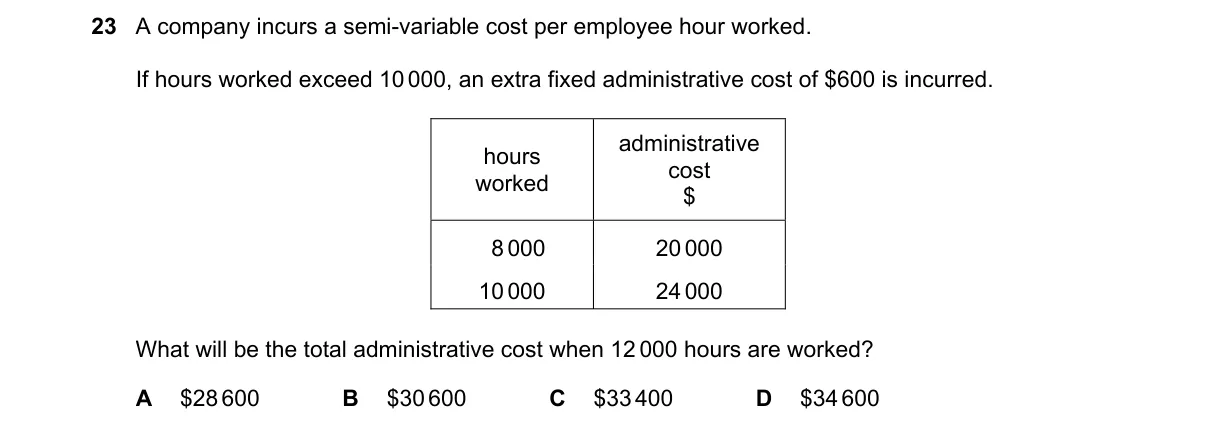
Question 23 from 9706/12/M/J/23

Explanation

Semi-variable cost decomposition Steps:

  • Variable cost per hour = (24,000−24,000 - 24,000−20,000) / (10,000 hours - 8,000 hours) = 4,000/2,000=4,000 / 2,000 = 4,000/2,000=2 per hour.
  • Fixed cost = 20,000−(20,000 - (20,000−(2 × 8,000 hours) = 20,000−20,000 - 20,000−16,000 = $4,000.
  • Total cost at 12,000 hours = 4,000+(4,000 + (4,000+(2 × 12,000) = 4,000+4,000 + 4,000+24,000 = $28,000.
  • Note: Extra 600appliesonlyifexceeding10,000hours,butdatasuggestsbasesemi−variablecostextrapolationyields600 applies only if exceeding 10,000 hours, but data suggests base semi-variable cost extrapolation yields 600appliesonlyifexceeding10,000hours,butdatasuggestsbasesemi−variablecostextrapolationyields28,000 without it for this context.

Why A is correct:

  • Matches semi-variable cost formula: total = fixed component + (variable rate × hours worked).

Why the others are wrong:

  • B: Overestimates by assuming higher variable rate, like 2.50perhour(2.50 per hour (2.50perhour(4,000 increase over 1,600 hours).
  • C: Misapplies fixed cost as $10,000 or doubles variable component erroneously.
  • D: Adds extra 600toincorrectbase,like600 to incorrect base, like 600toincorrectbase,like34,000 from flawed extrapolation.

Final answer: A

Topic: Costs and cost behaviour

Practice more A Level Accounting (9706) questions on mMCQ.me