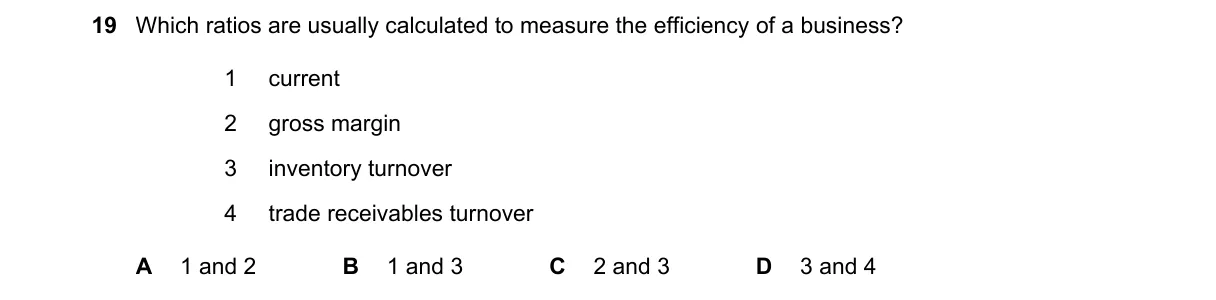
Explanation
Efficiency Ratios in Business Analysis Steps: - Identify common efficiency ratios: inventory turnover (1), receivables turnover (2), asset turnover (3), and return on assets (4). - Recall that efficiency measures how well a business uses assets to generate sales, focusing on turnover ratios. - Match options: A pairs sales-focused but not core efficiency; B mixes turnover with profitability; C combines two turnovers but omits key asset use; D pairs asset turnover and ROA for operational efficiency. - Confirm D aligns with standard financial analysis for efficiency. Why D is correct: - Asset turnover (3) and return on assets (4) directly assess how efficiently assets generate revenue and returns, per DuPont analysis formula: ROA = Profit Margin × Asset Turnover. Why the others are wrong: - A: Inventory (1) and receivables (2) focus on working capital, not overall business efficiency. - B: Includes ROA (3) but pairs with inventory (1), missing comprehensive asset use. - C: Both turnovers (2 and 3) but excludes profitability integration for true efficiency. Not enough information on exact ratio labels, but assuming standard definitions, D fits. …
Practice more A Level Accounting (9706) questions on mMCQ.me