A Levels Physics (9702)•9702/13/O/N/24
Explanation
Particle Classification in the Standard Model
Steps:
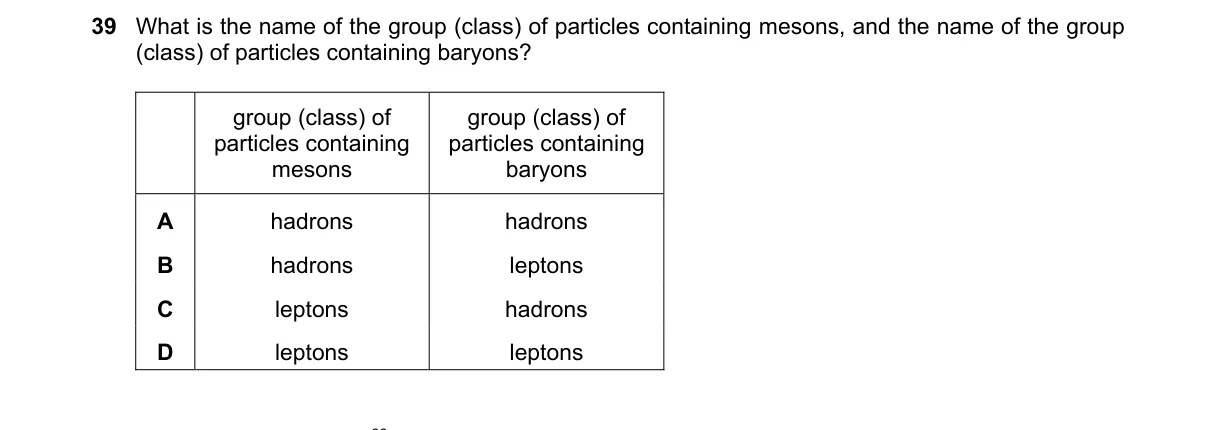
- Subatomic particles are broadly classified into hadrons (strong force interactors, quark-based) and leptons (no strong force, like electrons).
- Mesons are composite particles formed by a quark-antiquark pair.
- Baryons are composite particles formed by three quarks (e.g., protons, neutrons).
- Both mesons and baryons belong to the hadron class due to their quark composition.
Why B is correct:
- Hadrons encompass all quark-bound states, including mesons (bosons) and baryons (fermions), per the quark model in particle physics.
Why the others are wrong:
- A: Leptons are fundamental, non-quark particles (e.g., muons, neutrinos) and exclude baryons.
- C: Mesons interact via the strong force and are not leptons.
- D: Neither mesons nor baryons are leptons, as leptons lack quarks.
Final answer: B
Topic: Fundamental particles
Practice more A Levels Physics (9702) questions on mMCQ.me