Explanation
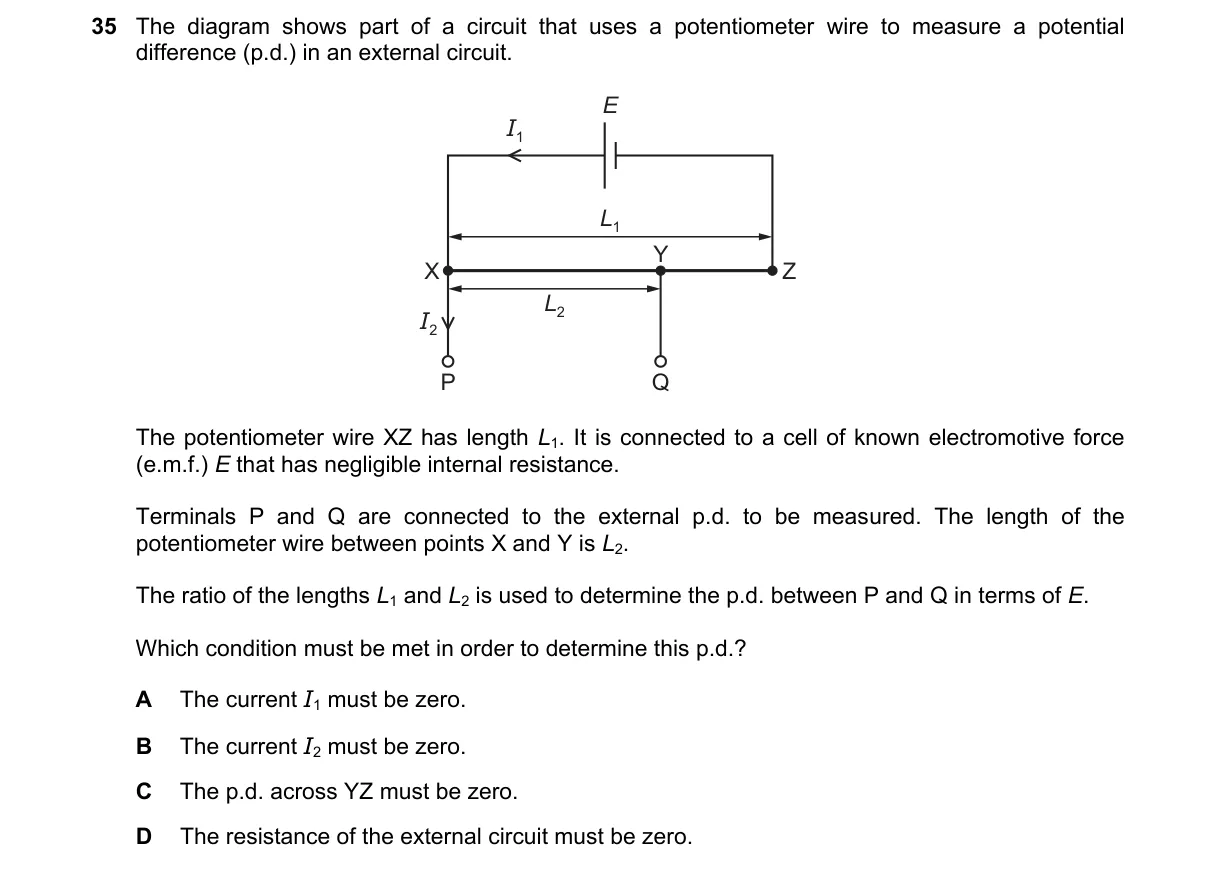
Potentiometer Balance Condition Steps: - The potentiometer wire XY of length L is connected across a cell of emf E, creating a uniform pd gradient of E/L per unit length. - The external circuit with unknown pd (say ε between P and Q) is connected such that one terminal links to X and the other to a jockey point Z on the wire via a galvanometer. - Slide the jockey to point Z where the galvanometer shows null deflection. - At this balance, ε equals the pd across XZ, given by ε = (L1/L) E, where L1 is length XZ; the total wire length is L = L1 + L2. Why B is correct: - At balance, the pd across YZ (from Y to Z via galvanometer) is zero by definition, ensuring no current flows and the wire pd matches ε exactly (Kirchhoff's voltage law). Why the others are wrong: - A: Current I in the main circuit is not zero; it's essential to establish the pd gradient along XY. - C: External circuit resistance need not be zero; potentiometer …
Practice more A Levels Physics (9702) questions on mMCQ.me