A Levels Physics (9702)•9702/12/O/N/24
Explanation
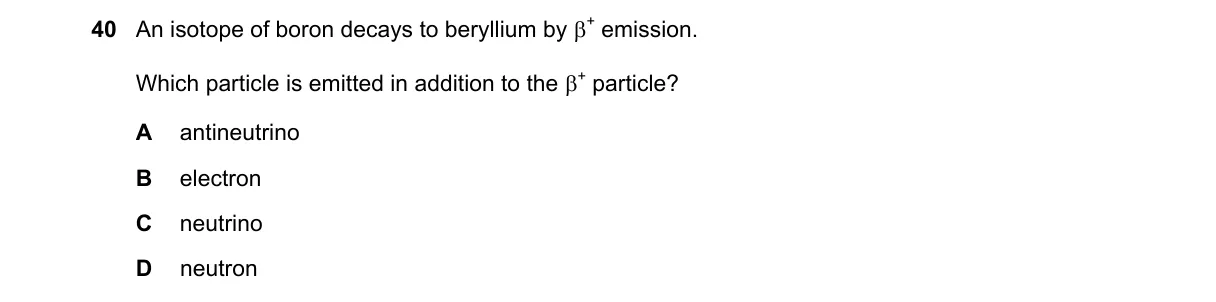
Beta-plus decay emits a positron and neutrino
Steps:
- Identify the decay type: Boron (Z=5) to beryllium (Z=4) decreases atomic number by 1, indicating beta-plus (β+) decay.
- Recall β+ process: A proton converts to a neutron, emitting a positron (β+ particle) and a neutrino to conserve energy, lepton number, and charge.
- Confirm particles: The β particle is the positron; the additional particle is the neutrino.
- Rule out alternatives: No neutron or electron emission occurs in this process.
Why C is correct:
- In β+ decay, the reaction p → n + e+ + ν_e requires a neutrino to balance lepton number and conserve momentum, per the weak interaction law.
Why the others are wrong:
- A: Antineutrino is emitted in β- decay, not β+.
- B: Electron is the β- particle, absent in β+ decay.
- D: Neutron emission would change mass number without altering Z this way.
Final answer: C
Topic: Radioactive decay
Practice more A Levels Physics (9702) questions on mMCQ.me