Explanation
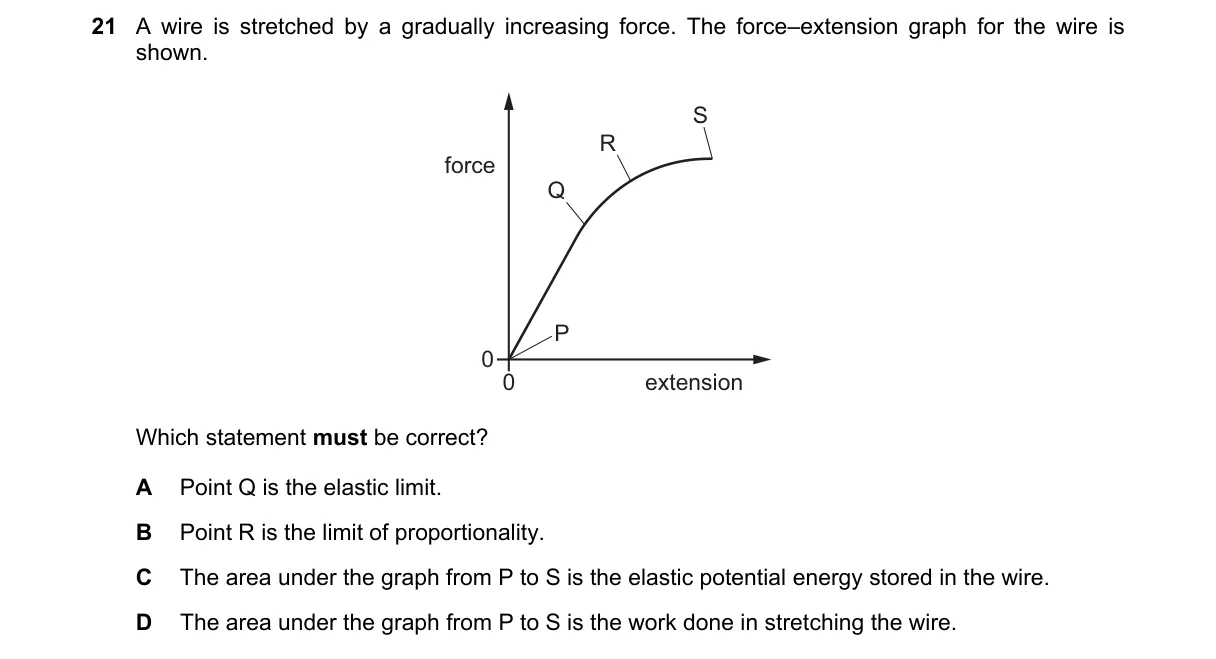
Area under force-extension graph represents work done Steps: - Recall that the force-extension graph plots force (y-axis) against extension (x-axis), so area under the curve equals work done (force × distance). - Identify points: Assume P is origin, R is proportionality limit, S is end of elastic region based on typical wire graphs. - Evaluate A: Limit of proportionality is where Hooke's law holds (straight line), but without graph, R's position is unclear. - Check B–D: Area from P to S is ∫F dx, which is work input; for elastic, it equals stored energy, but statement must hold generally. Why D is correct: - Work done stretching the wire is defined as ∫F dx over extension, exactly the area under the force-extension graph (work-energy theorem). Why the others are wrong: - A: Point R could be yield point, not necessarily proportionality limit without graph details. - B: Elastic potential energy equals area only if fully elastic; beyond proportionality, some work dissipates as heat. - C: Identical to D but phrased differently; however, D precisely matches the work done on the …
Practice more A Levels Physics (9702) questions on mMCQ.me