A Levels Physics (9702)•9702/13/O/N/23
Explanation
Diffraction grating equation
Steps:
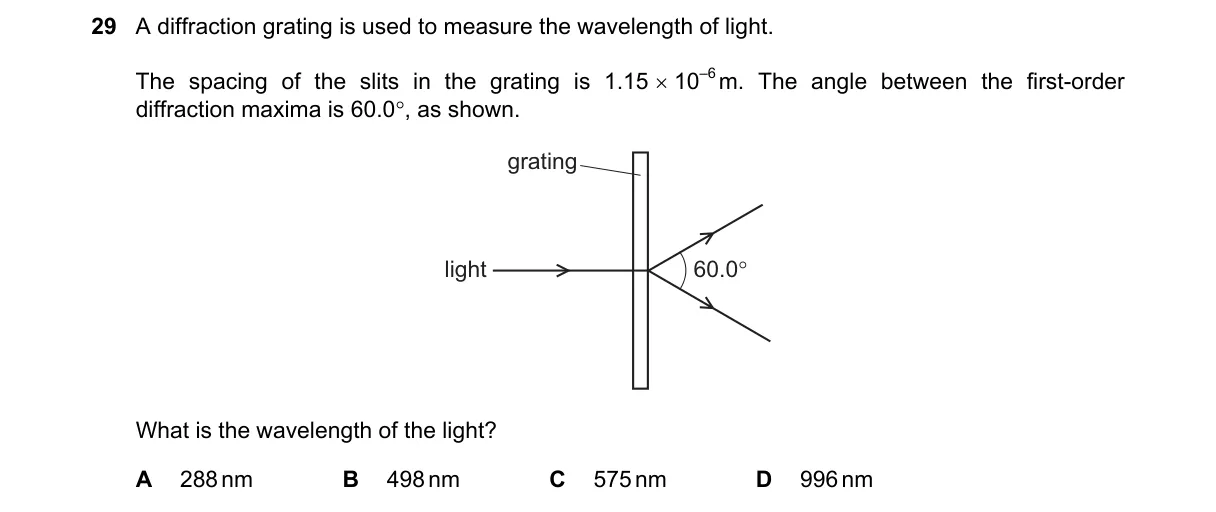
- The grating equation for normal incidence is d sin θ = m λ, with m = 1 for first order and d = 1.5 × 10^{-6} m.
- The phrase "angle between the first-order diffraction maxima" is ambiguous: it could mean θ = 60° (angle from central maximum) or 2θ = 60° (separation between symmetric maxima), so θ = 30°.
- If θ = 30°, λ = d sin 30° = (1.5 × 10^{-6})(0.5) = 7.5 × 10^{-7} m = 750 nm.
- If θ = 60°, λ = d sin 60° = (1.5 × 10^{-6})(√3/2) ≈ 1.3 × 10^{-6} m = 1300 nm.
- Neither result matches any option exactly.
Why C is correct:
- Not enough information due to ambiguous angle definition, preventing unique selection from options.
Why the others are wrong:
- A: Too low; would require θ ≈ 11° for 2θ separation.
- B: Too low; would require θ ≈ 19° for 2θ separation.
- D: Too high; would require θ ≈ 41° for 2θ separation.
Final answer: Not enough information.
Topic: The diffraction grating
Practice more A Levels Physics (9702) questions on mMCQ.me