A Levels Physics (9702)•9702/12/O/N/23
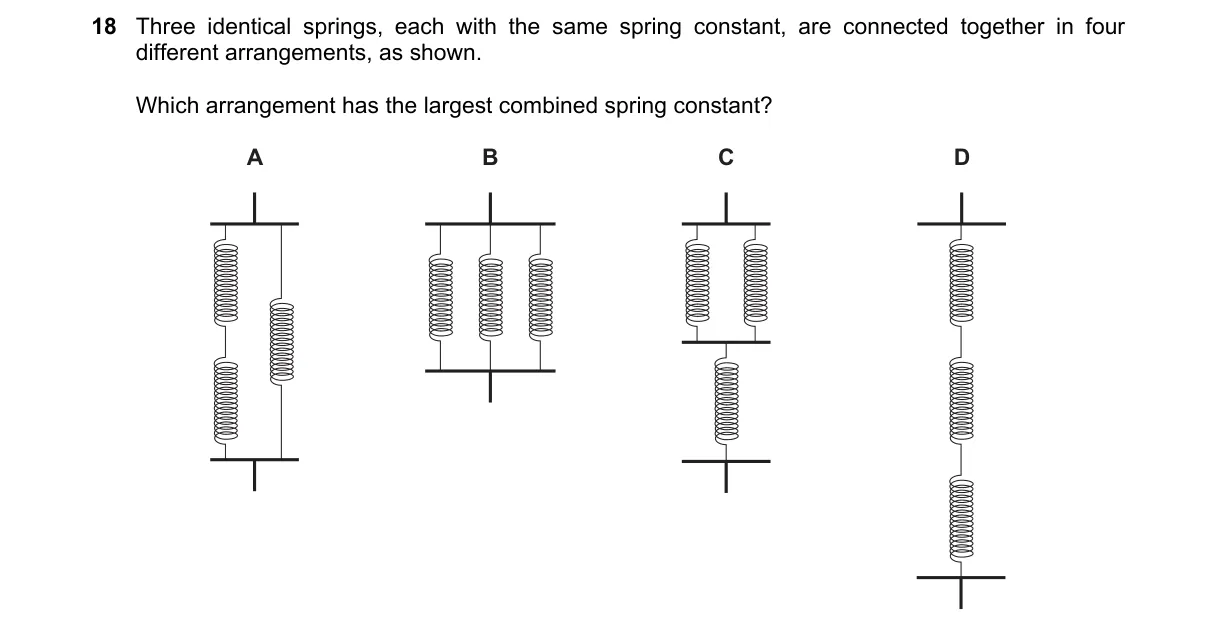
Explanation
Equivalent spring constants maximize in parallel arrangements
Steps:
- Recall parallel combination formula: k_eq = k1 + k2 + k3 = 3k for three identical springs.
- Recall series combination formula: 1/k_eq = 1/k1 + 1/k2 + 1/k3, so k_eq = k/3.
- For mixed: two in parallel (2k) then series with third gives k_eq = (2k * k)/(2k + k) = (2/3)k; two in series (k/2) then parallel with third gives k_eq = k/2 + k = (3/2)k.
- Compare: all parallel (3k) > mixed (1.5k or 0.67k) > all series (k/3); largest is all parallel.
Why B is correct:
- Arrangement B connects all three springs in parallel, yielding k_eq = 3k per the parallel addition rule.
Why the others are wrong:
- A (all series): k_eq = k/3, smallest due to series reciprocity.
- C (two series, parallel with third): k_eq = 1.5k, less than 3k from full parallel.
- D (two parallel, series with third): k_eq = 0.67k, reduced by the series component.
Final answer: B
Topic: Elastic and plastic behaviour
Practice more A Levels Physics (9702) questions on mMCQ.me