A Levels Physics (9702)•9702/12/O/N/23
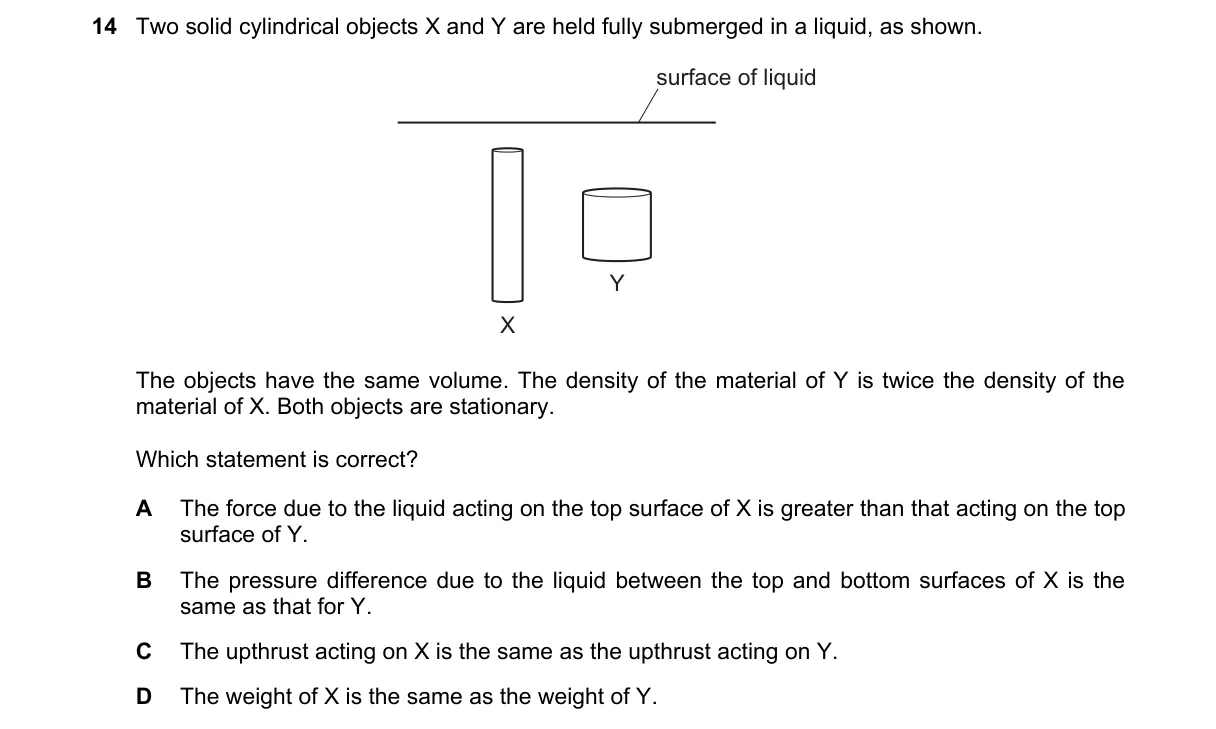
Explanation
Archimedes' Principle Determines Equal Upthrust Steps:
- Both X and Y have identical volumes and are fully submerged, displacing the same volume of liquid.
- Upthrust equals the weight of displaced liquid: upthrust = ρ_liquid × g × V_displaced.
- Since V_displaced is the same, upthrust is identical for X and Y.
- Stationary condition implies holding forces balance the weights, but upthrust remains equal.
Why C is correct:
- Upthrust depends solely on the volume of liquid displaced, which is equal for both objects per Archimedes' principle.
Why the others are wrong:
- A: Force on top surface = pressure at top × top area; depths and areas may differ, so not necessarily greater for X.
- B: Pressure difference = ρ_liquid × g × height; heights may differ despite equal volumes, so not necessarily the same.
- D: Weight = material density × volume × g; Y's density is twice X's with equal volume, so Y's weight is twice X's.
Final answer: C
Topic: Density and pressure
Practice more A Levels Physics (9702) questions on mMCQ.me