A Levels Physics (9702)•9702/13/O/N/22
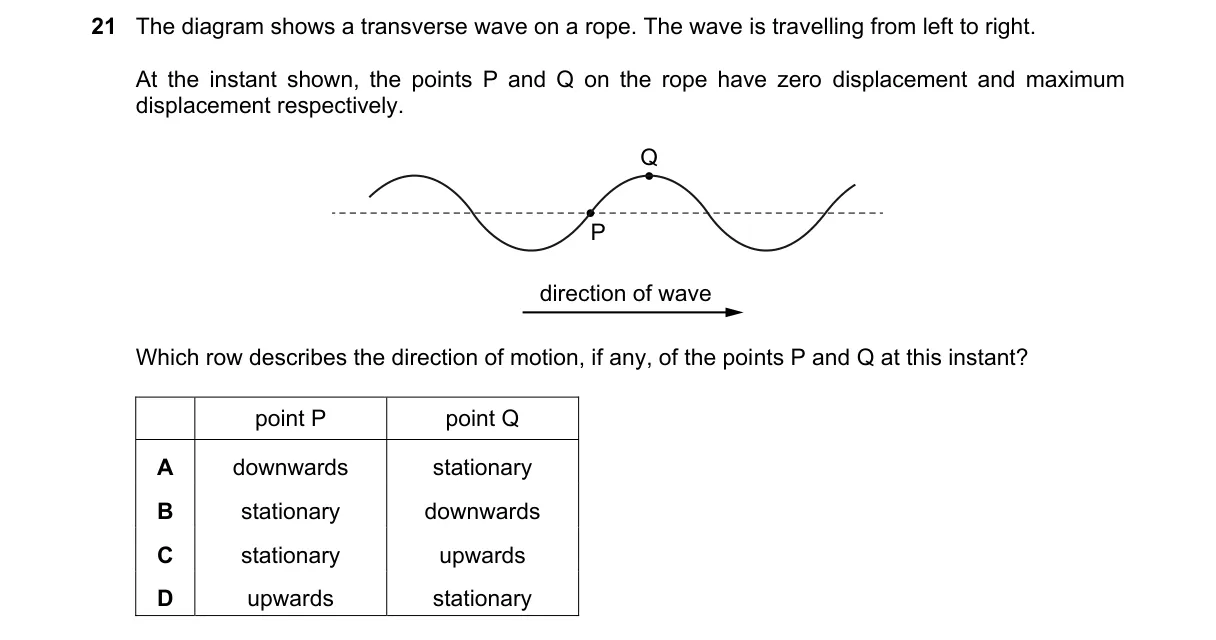
Explanation
Transverse wave particle motion at equilibrium and crest
Steps:
- Identify point Q at maximum displacement as a crest, where transverse velocity is zero, so stationary.
- Identify point P at zero displacement as passing through equilibrium, where transverse velocity is maximum.
- For a rightward-traveling wave, particles at equilibrium move perpendicular to propagation; direction depends on local slope.
- At P (zero displacement before a downward slope), motion is downward; Q remains stationary.
Why A is correct:
- In transverse waves, crest particles (max displacement) have zero velocity per simple harmonic motion, while equilibrium particles move at maximum speed; downward at P matches the wave's descending phase.
Why the others are wrong:
- B: Q moves downward, but max displacement means zero velocity.
- C: P moves upward, contradicting the descending equilibrium position.
- D: Q moves upward, but max displacement means stationary.
Final answer: A
Topic: Transverse and longitudinal waves
Practice more A Levels Physics (9702) questions on mMCQ.me