A Levels Physics (9702)•9702/12/O/N/22
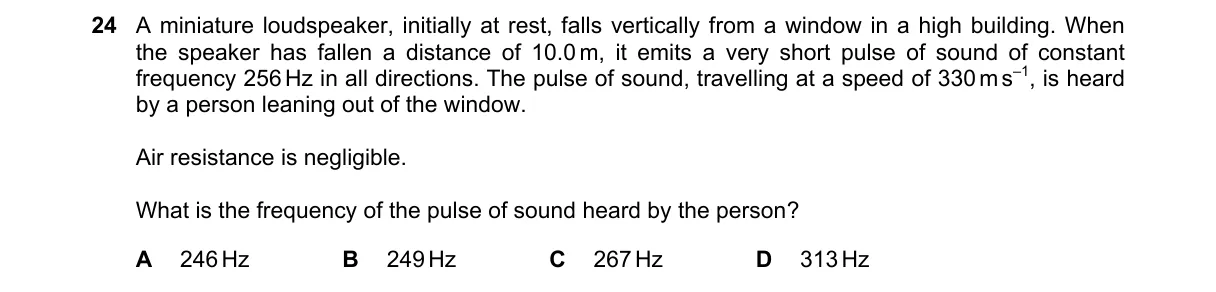
Explanation
Doppler effect for source moving away from observer
Steps:
- Calculate source speed after falling 10 m: m/s downward.
- Observer is stationary at window; source moves away, so use formula , where m/s and Hz.
- Substitute: Hz.
- Round to nearest option.
Why A is correct:
- Matches Doppler formula for receding source, lowering frequency below 256 Hz.
Why the others are wrong:
- B: Underestimates speed or rounding error; actual calculation yields 246 Hz.
- C: Applies approaching source formula , increasing frequency.
- D: Ignores Doppler effect, using original 256 Hz plus miscalculation.
Final answer: A
Topic: Doppler effect for sound waves
Practice more A Levels Physics (9702) questions on mMCQ.me