A Levels Physics (9702)•9702/11/O/N/22
Explanation
Standing wave amplitude in closed tube
Steps:
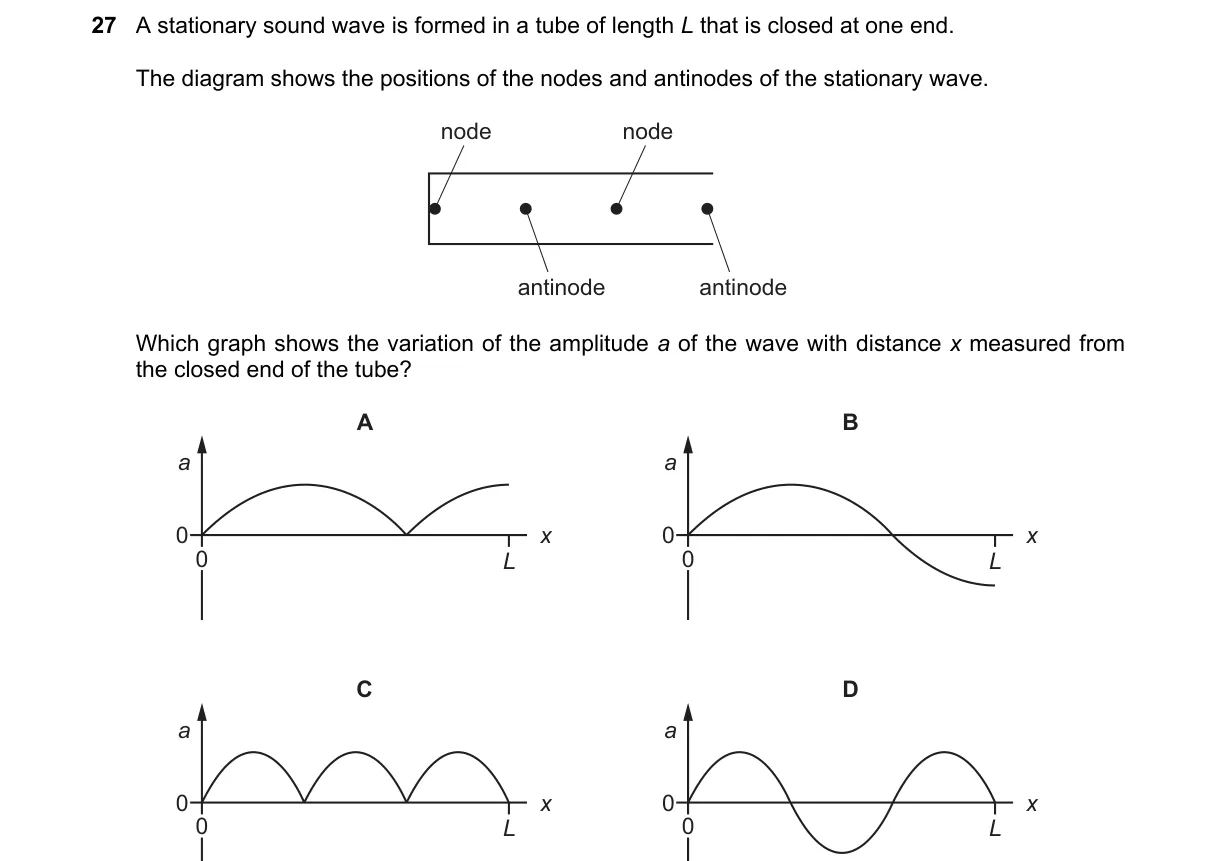
- Identify closed end as displacement node (amplitude zero) and open end as antinode (maximum amplitude).
- For fundamental mode, tube length L equals quarter wavelength (λ/4).
- Displacement amplitude varies as a = A sin(πx / (2L)), starting at zero at x=0 and peaking at x=L.
- Match graph to this sinusoidal increase from node to antinode.
Why A is correct:
- Graph A depicts amplitude rising from zero at closed end to maximum at open end, consistent with sin(πx / (2L)) for λ=4L.
Why the others are wrong:
- B shows constant amplitude, ignoring node-antinode positions.
- C has maximum at closed end, contradicting displacement node there.
- D exhibits multiple peaks, suggesting higher harmonic not matching fundamental mode.
Final answer: A
Topic: Stationary waves
Practice more A Levels Physics (9702) questions on mMCQ.me