A Levels Physics (9702)•9702/11/O/N/22
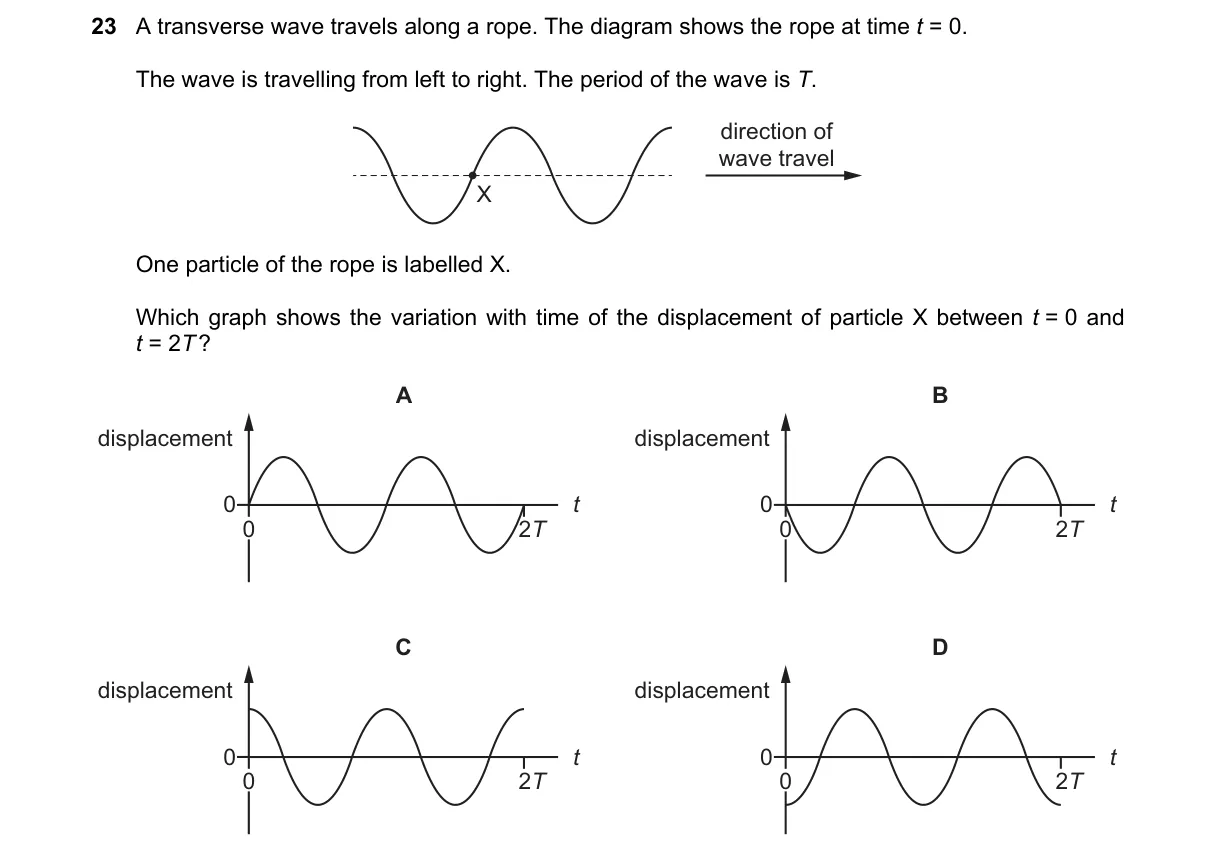
Explanation
Particle Displacement in Transverse Waves Follows Sinusoidal Motion
Steps:
- Examine the diagram at t=0 to find particle X's initial displacement and direction of motion.
- Note the wave travels left to right, so X's displacement oscillates with period T as the wave profile passes.
- For a standard transverse wave, displacement y = A sin(ωt + φ), where phase φ depends on X's position at t=0.
- Over 2T, the graph completes two full cycles, starting from X's initial state.
Why B is correct:
- B matches the upward-starting sine wave, as particle X at t=0 is at equilibrium and begins moving upward, per the wave's crest approaching from the left (sine wave definition y = A sin(2πt/T)).
Why the others are wrong:
- A shows a downward-starting sine wave, contradicting X's initial upward motion.
- C depicts a cosine-like downward oscillation, mismatched to the phase at t=0.
- D is an inverted upward sine, opposite to the wave's transverse direction.
Final answer: B
Topic: Transverse and longitudinal waves
Practice more A Levels Physics (9702) questions on mMCQ.me