Explanation
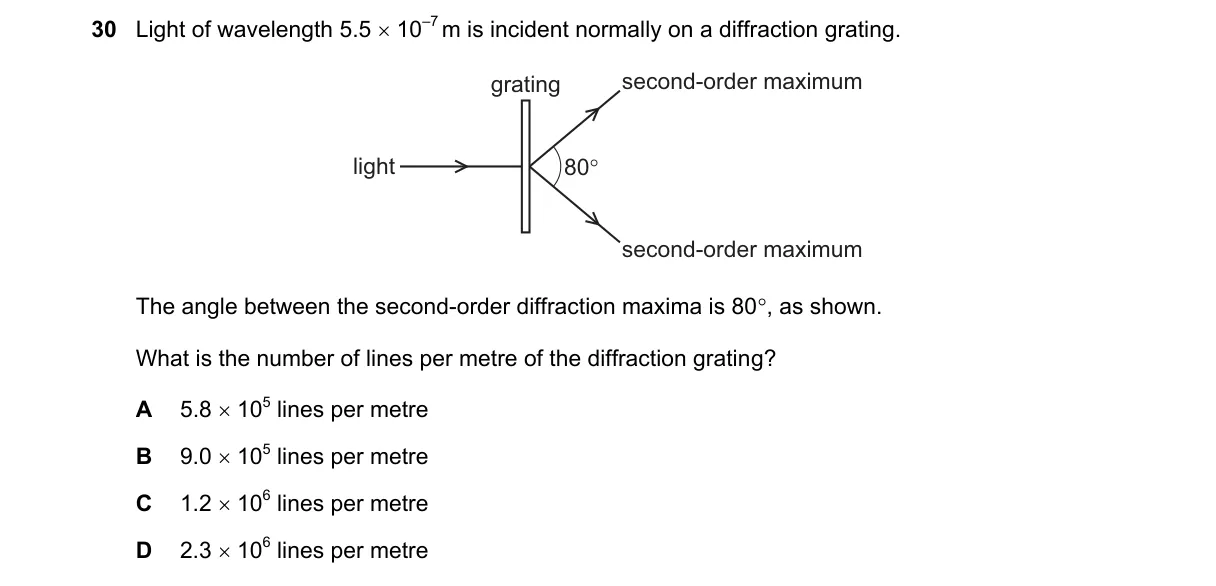
Diffraction grating positions for second-order maximum and adjacent minimum Steps: - Second-order maximum at sin θ_m = 2λ/d; adjacent minimum (between orders 2 and 3) at sin θ_n = 2.5λ/d. - Angle between positions on opposite sides of normal is θ_m + θ_n = 80°. - Set θ_n = 80° - θ_m, so sin(80° - θ_m) = 1.25 sin θ_m. - Expand and solve: tan θ_m = sin 80°/(1.25 + cos 80°) ≈ 0.692; θ_m ≈ 35°; sin θ_m ≈ 0.58; d = 2λ/0.58 ≈ 1.72 × 10^{-6} m; N = 1/d = 5.8 × 10^5 lines/m. Why A is correct: - Matches the solved N from grating equation and 80° separation between second-order maximum and following minimum on opposite sides. Why the others are wrong: - B: Uses preceding minimum at 1.5λ/d, yielding N ≈ 7.3 × 10^5 (or ≈9 × 10^5 if approximating same-side separation). - C: Assumes symmetric second-order maxima separation of 80° (θ_m = 40°), ignoring minimum; gives N = 1.0 × 10^6. - D: Excessively large N makes sin θ_2 > 1, impossible for observable …
Practice more A Levels Physics (9702) questions on mMCQ.me