A Levels Physics (9702)•9702/12/O/N/21
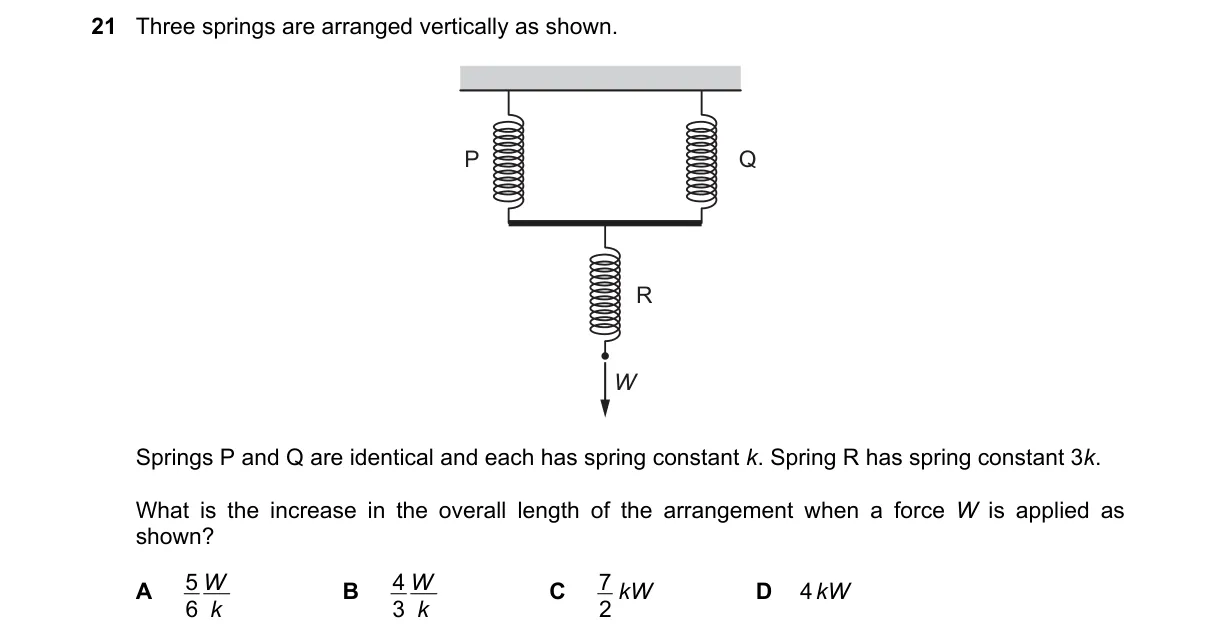
Explanation
Effective spring constant for series-parallel spring combination
Steps:
- Springs P and Q (each k) in parallel: equivalent constant = k + k = 2k.
- This 2k in series with R (3k): 1/K_eq = 1/(2k) + 1/(3k) = (3 + 2)/(6k) = 5/(6k).
- Thus, K_eq = 6k/5.
- Total length increase ΔL = W / K_eq = 5W/(6k).
Why A is correct:
- ΔL = 5W/6k follows Hooke's law for the series-parallel effective constant.
Why the others are wrong:
- B: 3W/4k assumes incorrect series combination, like all three in series (1/K_eq = 3/k, ΔL = 3W/k, not matching).
- C: 7W/2k overestimates extension, possibly treating all in parallel (K_eq = 5k, ΔL = W/5k, inverted error).
- D: W/k ignores parallel effect, treating as single k spring.
Final answer: A
Topic: Elastic and plastic behaviour
Practice more A Levels Physics (9702) questions on mMCQ.me