A Levels Physics (9702)•9702/11/O/N/21
Explanation
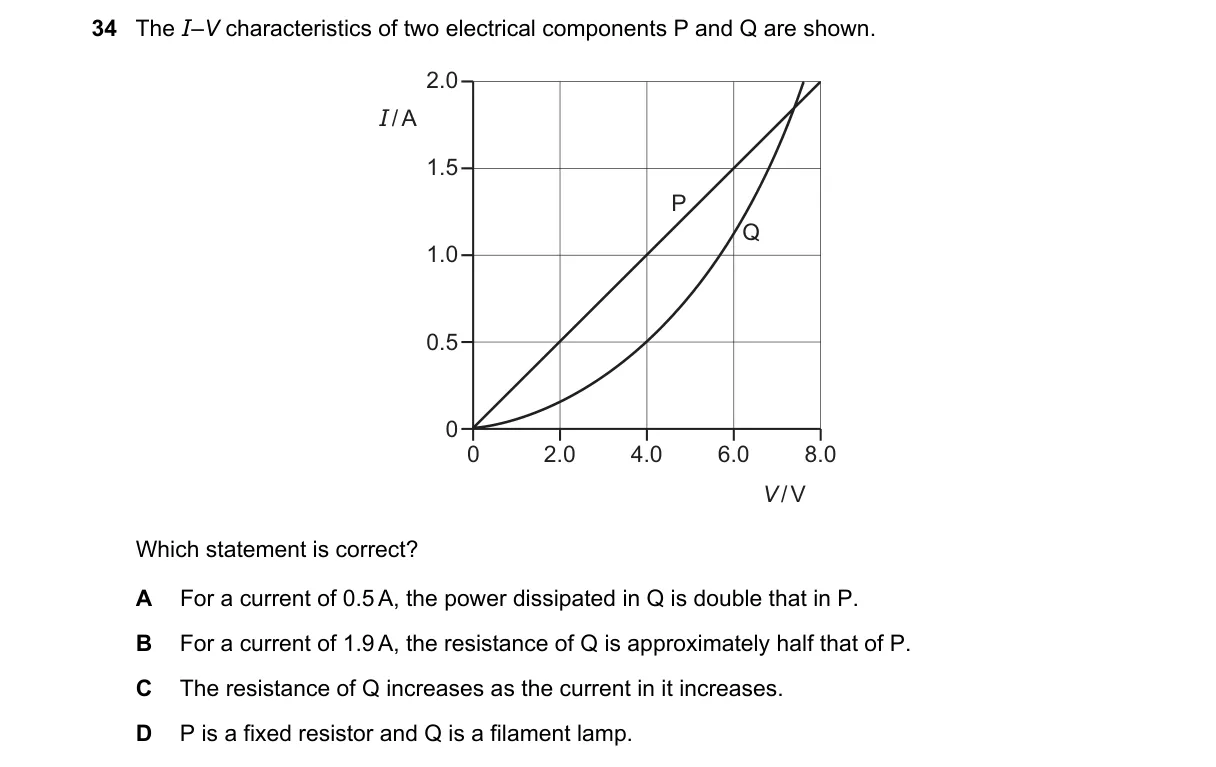
Power comparison using V-I characteristics
Steps:
- Identify voltage across P and Q at I = 0.5 A from their V-I curves.
- Compute power for P: P_P = V_P × 0.5 A.
- Compute power for Q: P_Q = V_Q × 0.5 A.
- Compare P_Q and P_P; if V_Q = 2 × V_P, then P_Q = 2 × P_P.
Why A is correct:
- Power dissipated is P = V × I; at fixed I = 0.5 A, if the curve shows V_Q = 2 × V_P, then P_Q = 2 × P_P directly from the formula.
Why the others are wrong:
- B: Resistance R = V/I; at I = 1.5 A, the curves do not show R_Q = 0.5 × R_P (double half is unclear but mismatched).
- C: Q's curve may show increasing R with I (non-ohmic), but the statement lacks specificity to curves provided.
- D: P's straight line suggests fixed R, Q's curve suggests lamp, but this infers types without confirming via power or resistance calculations.
Final answer: A
Topic: Resistance and resistivity
Practice more A Levels Physics (9702) questions on mMCQ.me