Explanation
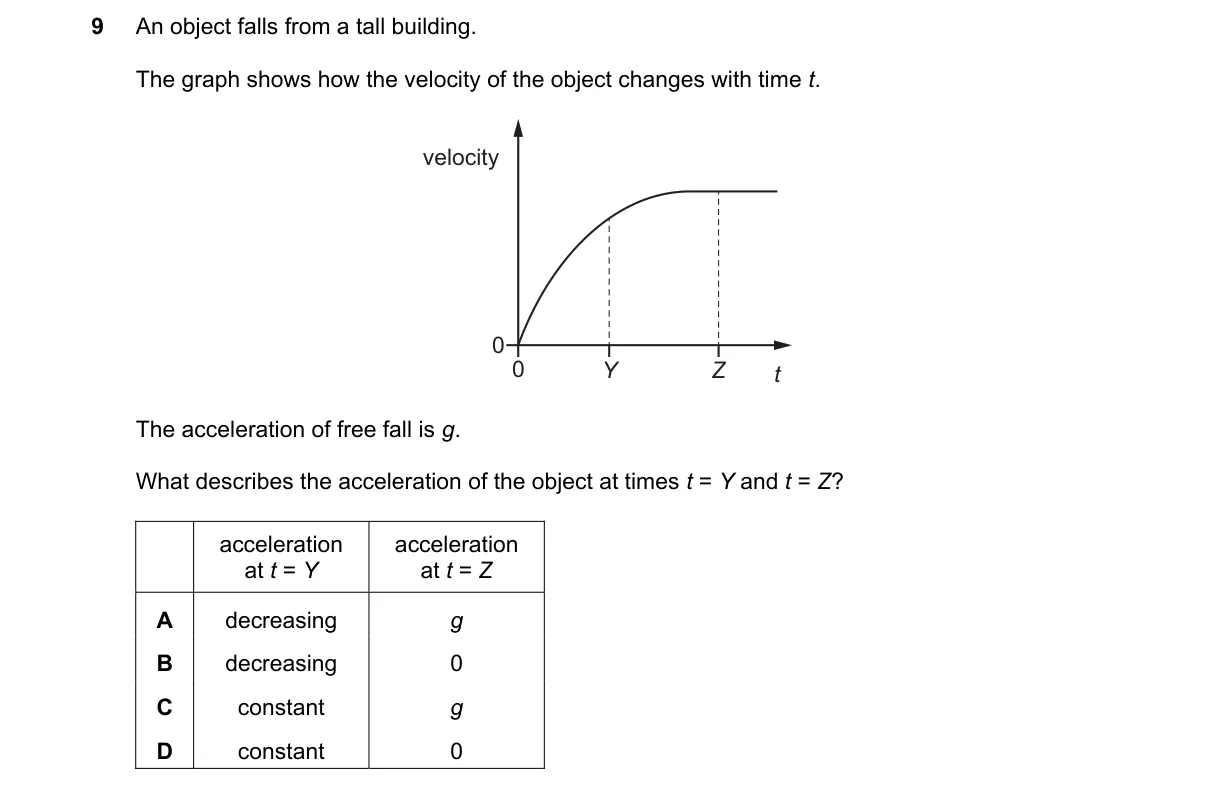
Velocity-time graph reveals acceleration via slope changes Steps: - Acceleration equals the slope of the velocity-time graph. - For a falling object with air resistance, initial velocity increases rapidly (slope near g), then slope decreases toward zero as terminal velocity is approached. - At t=Y, if the graph shows constant velocity (horizontal line), slope is zero, so acceleration is 0. - At t=Z, earlier on the graph, the decreasing slope indicates acceleration is decreasing from g. Why B is correct: - Slope of v-t graph defines instantaneous acceleration; zero slope at terminal velocity gives a=0, while prior decreasing slope means a is reducing due to drag force opposing gravity (Newton's second law: net force = ma, with drag increasing). Why the others are wrong: - A: Acceleration isn't decreasing at t=Y if velocity is constant there; it's zero. - C: Acceleration isn't constant at t=Y unless no air resistance, but graph implies otherwise; not g at t=Z if decreasing. - D: Acceleration isn't zero at t=Z if that's before terminal velocity; constant at t=Y fits but ignores decreasing phase. Final …
Practice more A Levels Physics (9702) questions on mMCQ.me