A Levels Physics (9702)•9702/11/O/N/20
Explanation
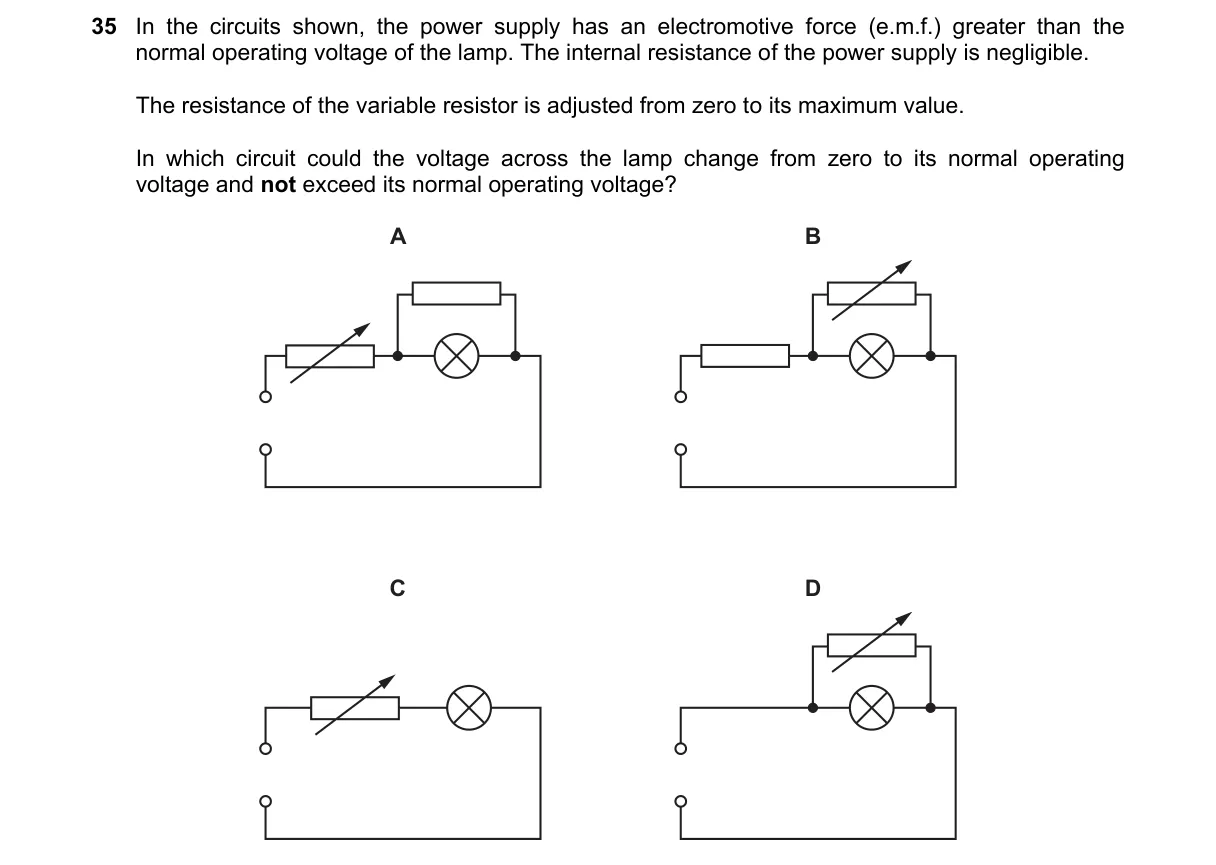
Potential divider with lamp across variable resistor
Steps:
- Analyze voltage across lamp: starts at zero when variable resistor is zero, increases as variable resistor rises.
- Use formula V_lamp = E × R_var / (R_fixed + R_var), where E > normal voltage.
- Ensure maximum R_var limits V_lamp to exactly normal operating voltage by choosing R_fixed appropriately.
- This setup monotonically increases V_lamp from 0 to normal without overshoot.
Why B is correct:
- In B, lamp across variable resistor in series with fixed resistor forms a divider; V_lamp rises from 0 to E × R_max / (R_fixed + R_max) = normal, per Ohm's law, never exceeding if R_fixed = E × R_max / normal - R_max.
Why the others are wrong:
- A: Lamp in series with variable resistor; V_lamp starts at E (exceeds normal) and decreases.
- C: Lamp across fixed resistor in divider; V_lamp starts at E (exceeds) and decreases.
- D: Lamp in parallel with variable resistor; V_lamp fixed at E (always exceeds).
Final answer: B
Topic: Potential dividers
Practice more A Levels Physics (9702) questions on mMCQ.me