A Levels Physics (9702)•9702/11/O/N/20
Explanation
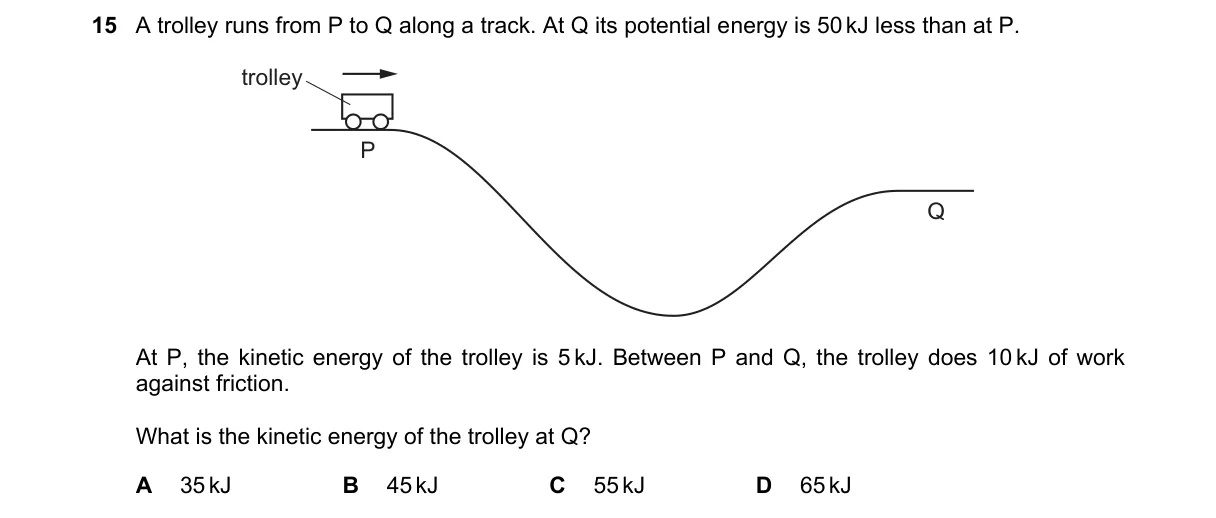
Conservation of mechanical energy accounting for frictional work
Steps:
- Initial mechanical energy at P: KE_P + PE_P = 5 kJ + PE_P
- Final mechanical energy at Q: KE_Q + PE_Q, where PE_Q = PE_P - 50 kJ
- Frictional work dissipates 10 kJ, so KE_Q + PE_Q = (KE_P + PE_P) - 10 kJ
- Substitute: KE_Q + (PE_P - 50) = 5 + PE_P - 10; simplify to KE_Q = 45 kJ
Why B is correct:
- Matches the work-energy theorem: change in mechanical energy equals non-conservative work done (-10 kJ).
Why the others are wrong:
- A ignores frictional loss, yielding 5 - 50 = -45 kJ (impossible).
- C subtracts only PE change from initial KE: 5 - 50 + 100? (misapplies conservation).
- D adds frictional work instead of subtracting: 5 - 50 + 10 + 50? (wrong sign).
Final answer: B
Topic: Energy conservation
Practice more A Levels Physics (9702) questions on mMCQ.me