A Levels Physics (9702)•9702/11/O/N/20
Explanation
Kinetic energy loss in perfectly inelastic collision
Steps:
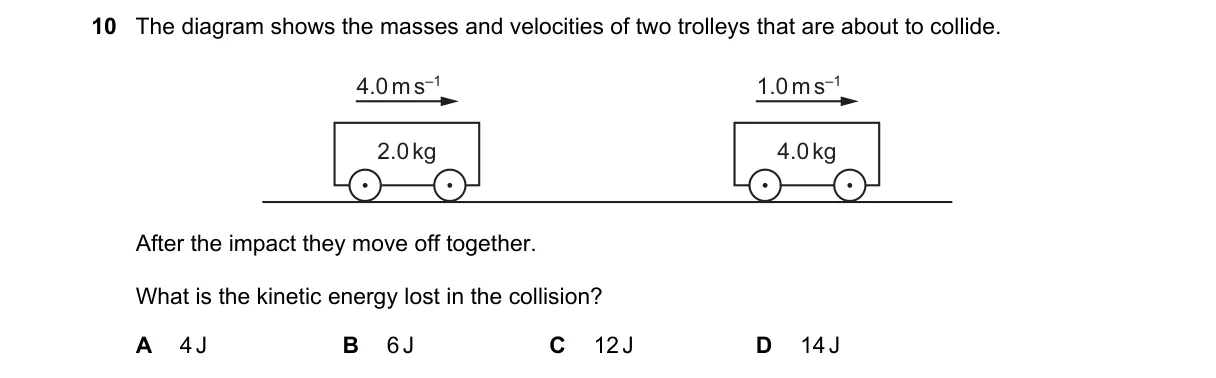
- Calculate initial KE for each trolley: trolley 1 (4 kg, 1 m/s) is ½×4×1² = 2 J; trolley 2 (2 kg, 2 m/s opposite) is ½×2×2² = 4 J; total initial KE = 6 J.
- Apply conservation of momentum: initial momentum = 4×1 + 2×(-2) = 0 kg m/s; total mass = 6 kg, so final velocity = 0 m/s.
- Calculate final KE: ½×6×0² = 0 J.
- KE lost = initial KE - final KE = 6 J - 0 J = 6 J.
Why B is correct:
- In a perfectly inelastic collision, objects stick together, so final KE uses common velocity from momentum conservation, yielding 6 J loss via ½mv² formula.
Why the others are wrong:
- A: Ignores contribution from second trolley's KE.
- C: Equals total initial KE, forgetting to subtract final KE.
- D: Overestimates by adding extraneous energy or misapplying velocities.
Final answer: B
Topic: Linear momentum and its conservation
Practice more A Levels Physics (9702) questions on mMCQ.me