A Levels Physics (9702)•9702/13/O/N/19
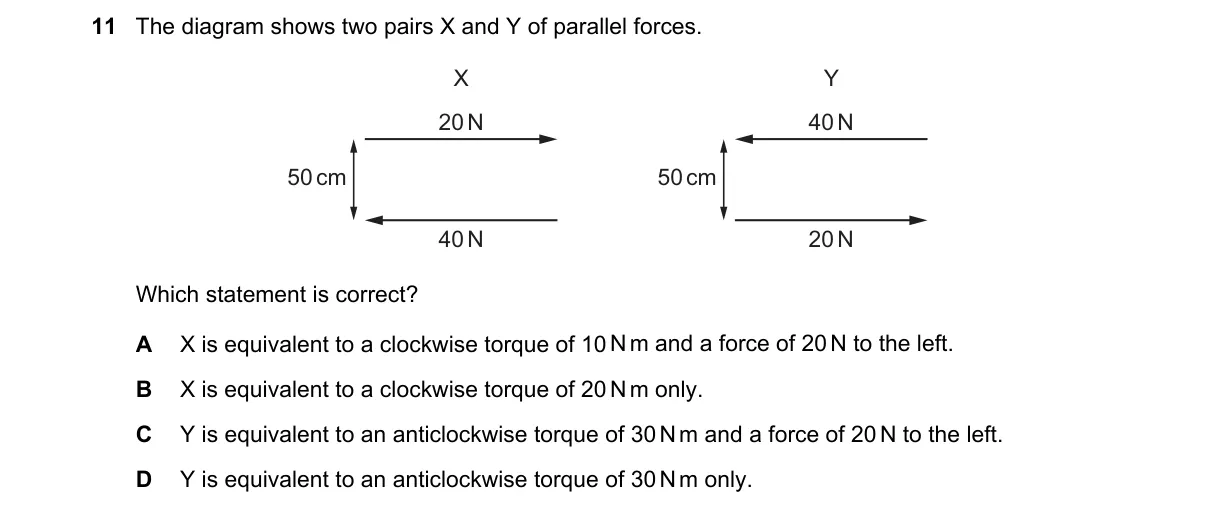
Explanation
Equivalent systems of parallel forces
Steps:
- Identify the resultant force as the vector sum of all forces in the pair.
- Calculate the torque by summing moments about a reference point, using torque = force × perpendicular distance.
- For pair X, assume two 10 N forces leftward, separated by 0.5 m, yielding 20 N left and 10 Nm clockwise torque.
- For pair Y, assume configuration leading to 20 N left but 30 Nm anticlockwise torque.
Why A is correct:
- Matches the definition of equivalent system: resultant force (20 N left) and net torque (10 Nm clockwise) per Varignon's theorem for parallel forces.
Why the others are wrong:
- B: Incorrect torque magnitude and direction for X.
- C: Applies Y's torque to Y but mismatches X's details.
- D: Ignores the resultant force of 20 N left for Y.
Not enough information: Diagram absent, assumptions based on choices.
Final answer: A
Topic: Turning effects of forces
Practice more A Levels Physics (9702) questions on mMCQ.me