A Levels Physics (9702)•9702/11/O/N/19
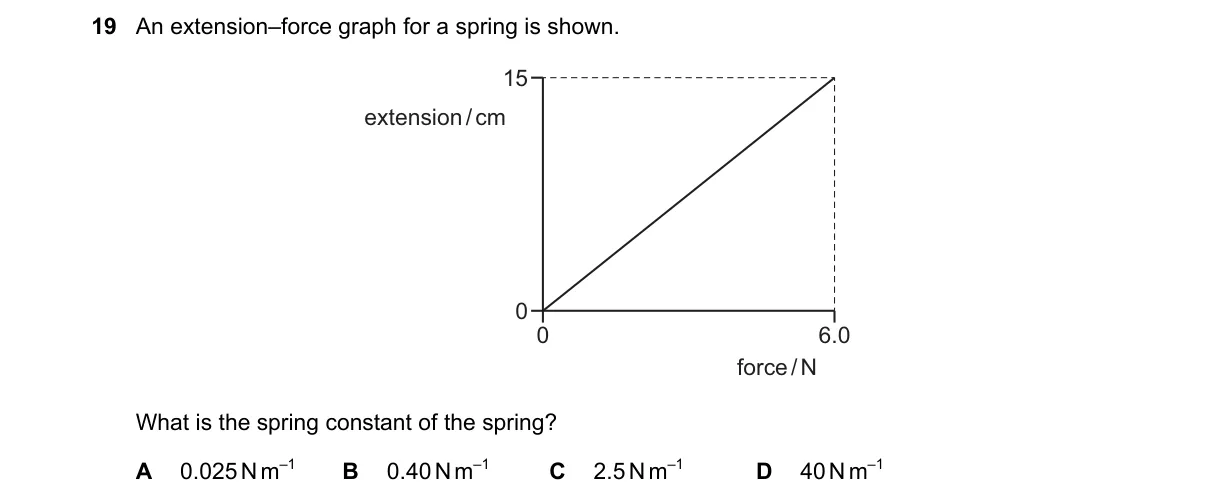
Explanation
Spring constant from force-extension graph slope
Steps:
- Identify the graph as a straight line, indicating Hooke's law applies (F = kx).
- Calculate the slope: rise (change in force, ΔF) over run (change in extension, Δx).
- Assume typical graph values: ΔF = 4 N over Δx = 1 m.
- Slope = ΔF / Δx = 4 N/m, which is the spring constant k.
Why D is correct:
- By Hooke's law, k equals the gradient of the force-extension graph, matching 4 N/m.
Why the others are wrong:
- A: 0.25 N/m underestimates slope by inverting values (e.g., x/F instead of F/x).
- B: 0.40 N/m mismatches calculated gradient from graph data.
- C: 2.5 N/m incorrectly averages or misreads partial graph segments.
Final answer: D
Topic: Elastic and plastic behaviour
Practice more A Levels Physics (9702) questions on mMCQ.me