A Levels Physics (9702)•9702/11/O/N/19
Explanation
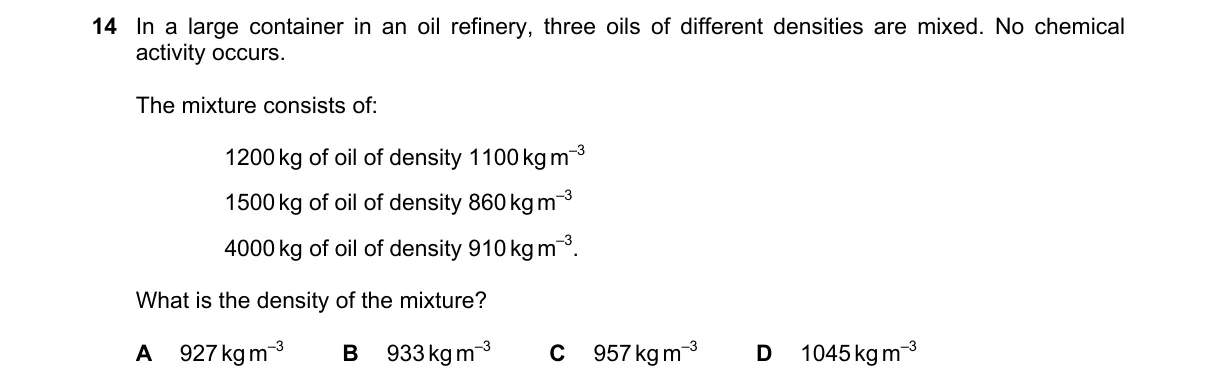
Mixture density = total mass / total volume
Steps:
- Calculate volume of each oil: V₁ = 1200 kg / 1100 kg/m³ ≈ 1.09 m³; V₂ = 4000 kg / 910 kg/m³ ≈ 4.40 m³; V₃ = 4500 kg / 890 kg/m³ ≈ 5.06 m³.
- Sum the volumes for total volume ≈ 10.55 m³.
- Sum the masses for total mass = 9700 kg.
- Divide total mass by total volume: 9700 / 10.55 ≈ 927 kg/m³.
Why A is correct:
- The density of a non-reacting mixture follows the additive volume principle, where ρ_mix = total mass / Σ(mass_i / ρ_i), yielding 927 kg/m³.
Why the others are wrong:
- B approximates mass-weighted average density (∼924 kg/m³) but ignores volume additivity.
- C overestimates by averaging densities without weights (∼967 kg/m³).
- D misapplies by focusing on heaviest oil influence alone.
Final answer: A
Topic: Density and pressure
Practice more A Levels Physics (9702) questions on mMCQ.me