A Levels Physics (9702)•9702/12/O/N/18
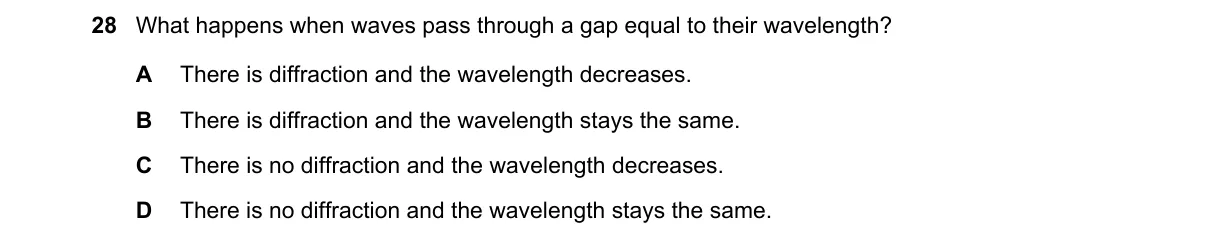
Explanation
Wave Diffraction Through a Gap
Steps:
- Waves diffract when passing through a gap comparable to their wavelength, causing spreading.
- For a gap equal to the wavelength, significant diffraction occurs as the gap size allows bending around edges.
- Diffraction alters the wave's path but does not change its intrinsic properties like wavelength.
- Wavelength remains constant, determined by the wave source and medium, not the obstacle.
Why A is correct:
- Huygens' principle states that every point on a wavefront acts as a source of secondary waves; with gap = wavelength, these interfere to produce diffraction without altering wavelength.
Why the others are wrong:
- B: Wavelength does not decrease; diffraction spreads waves but preserves wavelength.
- C: Diffraction does occur for gap = wavelength; no decrease in wavelength.
- D: Diffraction is present; waves do not propagate straight without spreading.
Final answer: A
Topic: Diffraction
Practice more A Levels Physics (9702) questions on mMCQ.me