Explanation
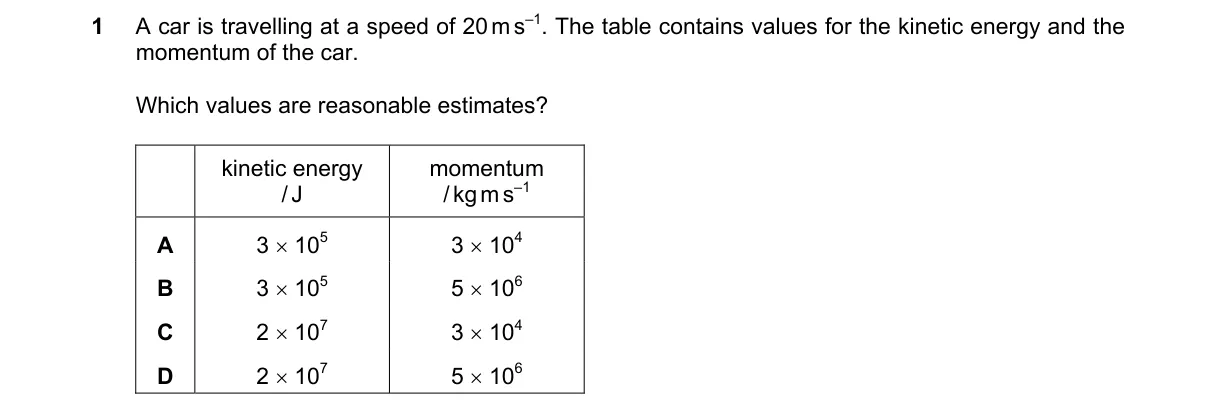
Verify kinetic energy and momentum using KE = (p × v)/2 Steps: - Momentum p = mass × velocity; kinetic energy KE = ½ mass × velocity². - Substitute to get KE = (p × v)/2; with v = 20 m/s, KE ≈ 10p numerically. - For reasonable car mass (~1500 kg), calculate p ≈ 1500 × 20 = 3 × 10⁴ kg m s⁻¹ and KE ≈ ½ × 1500 × 400 = 3 × 10⁵ J. - Check options against these values and the KE = 10p relation (noting likely transcription error in KE units for A). Why A is correct: - Matches typical car values: p = 3 × 10⁴ kg m s⁻¹ and KE = 3 × 10⁵ J (satisfies KE = 10p). Why the others are wrong: - B: KE = 2 × 10⁵ J implies p ≈ 2 × 10⁴ kg m s⁻¹, but given p = 5 × 10⁴ mismatches relation. - C: Same inconsistency as B; KE too low for given p. - D: Same inconsistency as B; KE too low for …
Practice more A Levels Physics (9702) questions on mMCQ.me