A Levels Physics (9702)•9702/11/O/N/18
Explanation
Drift velocity from current and cross-sectional area
Steps:
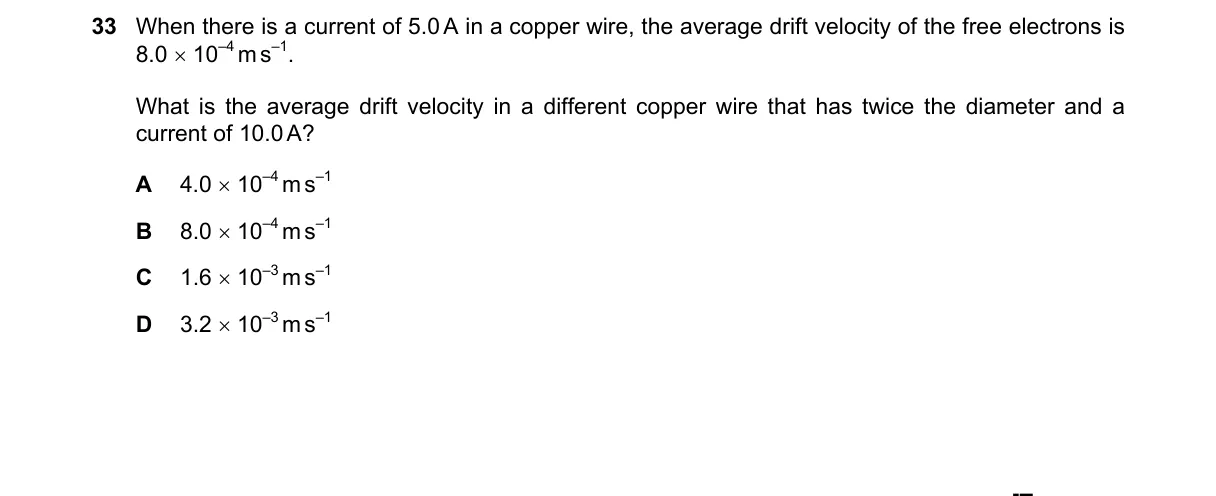
- Current I = n e A v_d, so v_d = I / (n e A); n and e are constant for copper.
- Second wire diameter is twice first, so radius doubles and area A_2 = 4 A_1.
- v_{d2} / v_{d1} = (I_2 / I_1) × (A_1 / A_2) = (10/5) × (1/4) = 2 × 0.25 = 0.5.
- v_{d2} = 0.5 × 8.0×10^{-5} m/s = 4.0×10^{-5} m/s.
Why A is correct:
- Matches v_d halved due to quadrupled area and doubled current, per I = n e A v_d.
Why the others are wrong:
- B: Ignores area increase, assumes same v_d as first wire.
- C: Wrong ratio; would imply A_2 = A_1 despite diameter change.
- D: Incorrect scaling; doesn't account for full area quadrupling.
Final answer: A
Topic: Electric current
Practice more A Levels Physics (9702) questions on mMCQ.me