A Levels Physics (9702)•9702/14/M/J/25
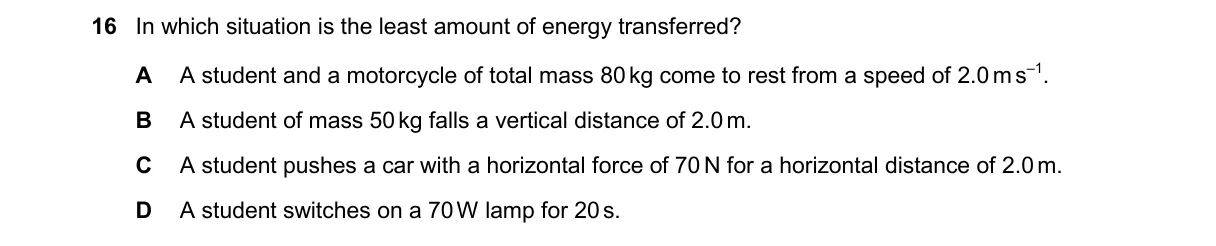
Explanation
Comparing energy transfers using work-energy principles
Steps:
- Calculate kinetic energy lost in A: J.
- Calculate gravitational potential energy in B: J.
- Calculate work done in C: J.
- Calculate electrical energy in D: J.
Why C is correct:
- It involves the smallest work transfer, J, per the work-energy theorem.
Why the others are wrong:
- A transfers 160 J of kinetic energy, more than C.
- B transfers about 1568 J of potential energy, much more than C.
- D transfers 1400 J of electrical energy, more than C.
Final answer: C
Topic: Gravitational potential energy and kinetic energy
Practice more A Levels Physics (9702) questions on mMCQ.me