A Levels Physics (9702)•9702/14/M/J/25
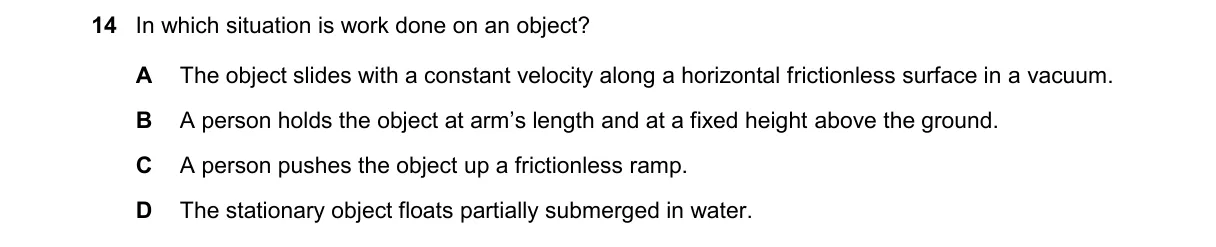
Explanation
Work requires net force parallel to displacement
Steps:
- Define work as , where positive work occurs if force and displacement align.
- Evaluate each option for applied force and object motion.
- Identify scenarios with zero displacement or zero net force component along motion.
- Select the case with clear force and parallel displacement.
Why C is correct:
- Pushing applies force with a component parallel to the ramp's displacement, so by work-energy theorem.
Why the others are wrong:
- A: Constant velocity on frictionless surface means net force is zero, so no work done.
- B: Object is held stationary, so displacement , work is zero.
- D: Object is stationary while floating, so displacement , work is zero.
Final answer: C
Topic: Gravitational potential energy and kinetic energy
Practice more A Levels Physics (9702) questions on mMCQ.me