A Levels Physics (9702)•9702/12/M/J/25
Explanation
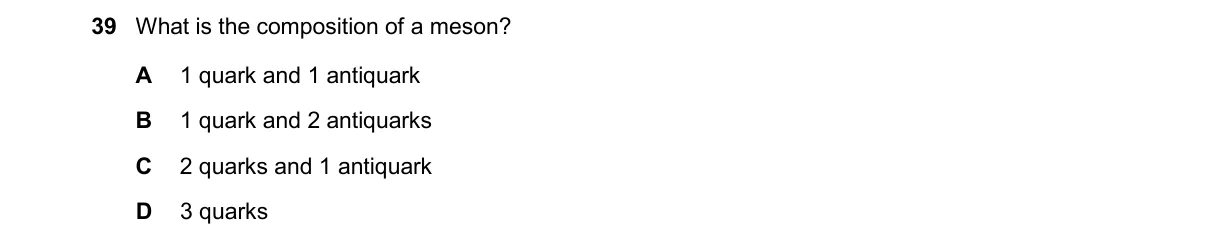
Mesons consist of a quark-antiquark pair
Steps:
- Recall that mesons are a type of hadron, subatomic particles held together by the strong nuclear force.
- Hadrons are classified into baryons and mesons based on quark content.
- Baryons contain three quarks, while mesons contain a quark and an antiquark.
- Confirm via particle physics: mesons have zero baryon number, matching one quark (+1/3) and one antiquark (-1/3).
Why A is correct:
- By definition in the quark model, mesons are bound states of one quark and one antiquark, satisfying their integer spin and mass properties.
Why the others are wrong:
- B: Two antiquarks with one quark would have negative baryon number, not matching mesons.
- C: Two quarks and one antiquark yield a net baryon number of +1/3, resembling unstable pentaquarks, not mesons.
- D: Three quarks define baryons like protons, not mesons.
Final answer: A
Topic: Fundamental particles
Practice more A Levels Physics (9702) questions on mMCQ.me